Ch. 1 - Functions
Briggs - Calculus: Early Transcendentals 3rd Edition
Briggs3rd EditionCalculus: Early TranscendentalsISBN: 9780136847243Not the one you use?Change textbook
Chapter 1, Problem 1.10

Let ƒ(x) = 1/ (x³+1).
Compute ƒ(2) and ƒ().

Verified step by step guidance
1
Identify the function given: \( f(x) = \frac{1}{x^3 + 1} \).
To compute \( f(2) \), substitute \( x = 2 \) into the function: \( f(2) = \frac{1}{2^3 + 1} \).
Simplify the expression for \( f(2) \): calculate \( 2^3 \) and add 1.
To compute \( f(y^2) \), substitute \( x = y^2 \) into the function: \( f(y^2) = \frac{1}{(y^2)^3 + 1} \).
Simplify the expression for \( f(y^2) \): calculate \( (y^2)^3 \) and add 1.

Verified video answer for a similar problem:

This video solution was recommended by our tutors as helpful for the problem above.
Video duration:
3m
Was this helpful?

Key Concepts

Here are the essential concepts you must grasp in order to answer the question correctly.

Function Evaluation

Function evaluation involves substituting a specific value into a function to determine its output. For example, to compute ƒ(2) for the function ƒ(x) = 1/(x³ + 1), you replace x with 2, resulting in ƒ(2) = 1/(2³ + 1) = 1/9.
Recommended video:
4:26
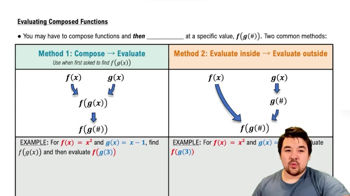
Evaluating Composed Functions

Polynomial Functions

A polynomial function is a mathematical expression involving a sum of powers in one or more variables multiplied by coefficients. In the function ƒ(x) = 1/(x³ + 1), the denominator x³ + 1 is a polynomial of degree three, which influences the behavior and properties of the function.
Recommended video:
6:04
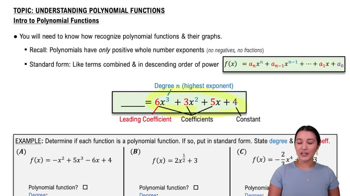
Introduction to Polynomial Functions

Substitution in Functions

Substitution in functions refers to replacing a variable with another expression or value. In this case, computing ƒ(y²) means substituting y² into the function, leading to ƒ(y²) = 1/((y²)³ + 1) = 1/(y^6 + 1), which allows for further analysis of the function's behavior based on the variable y.
Recommended video:
05:21
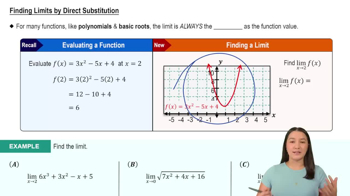
Finding Limits by Direct Substitution