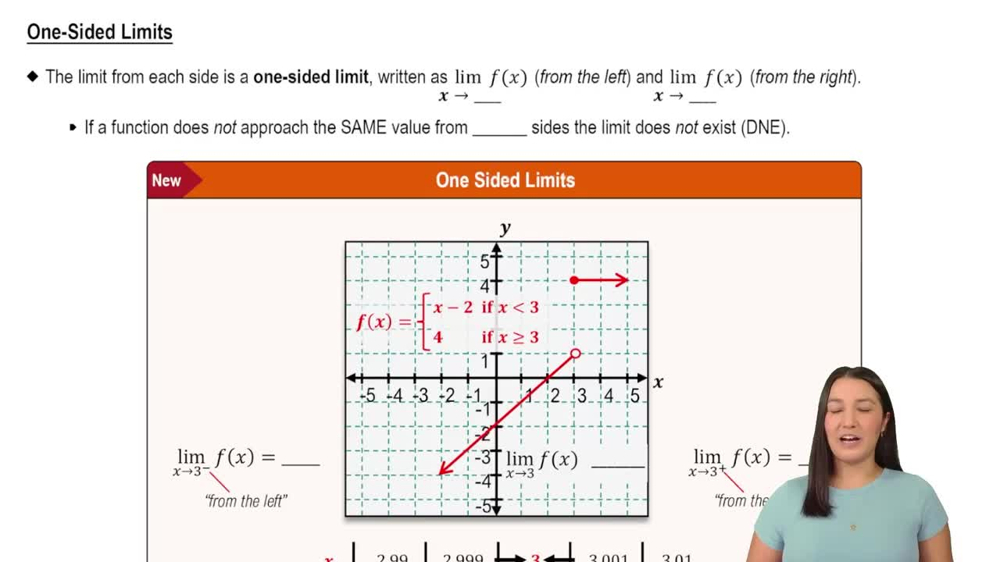
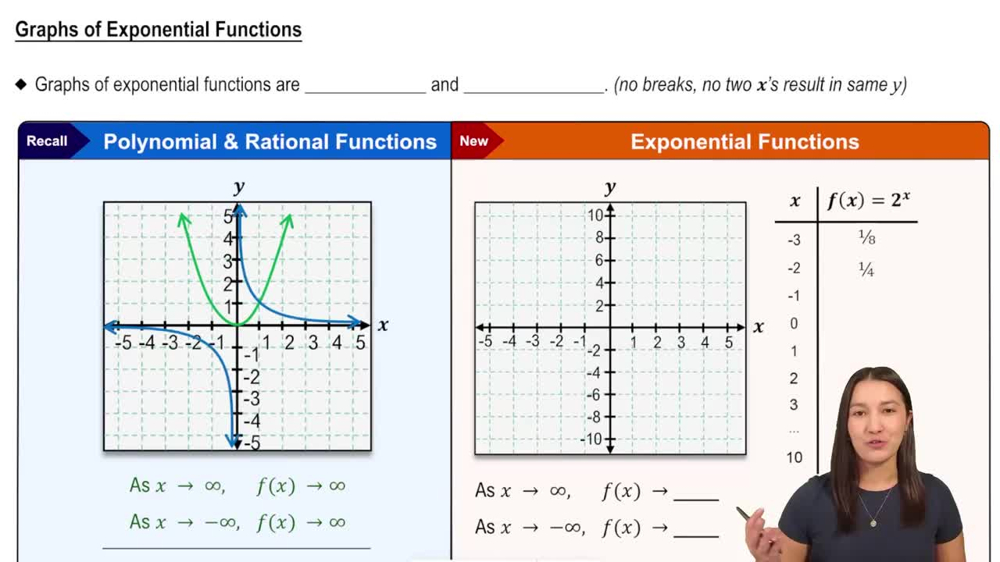
The hyperbolic cosine function, denoted , is used to model the shape of a hanging cable (a telephone wire, for example). It is defined as .
a. Determine its end behavior by analyzing and .
Verified step by step guidance
1
Step 1: Recall the definition of the hyperbolic cosine function: \( \cosh(x) = \frac{e^x + e^{-x}}{2} \).
Step 2: To find the end behavior as \( x \to \infty \), consider the terms \( e^x \) and \( e^{-x} \). As \( x \to \infty \), \( e^x \) grows very large while \( e^{-x} \) approaches zero.
Step 3: Therefore, as \( x \to \infty \), \( \cosh(x) \approx \frac{e^x}{2} \), which implies that \( \cosh(x) \to \infty \).
Step 4: Now, consider the behavior as \( x \to -\infty \). In this case, \( e^x \) approaches zero and \( e^{-x} \) grows very large.
Step 5: Thus, as \( x \to -\infty \), \( \cosh(x) \approx \frac{e^{-x}}{2} \), which also implies that \( \cosh(x) \to \infty \).
Verified video answer for a similar problem:
This video solution was recommended by our tutors as helpful for the problem above
Video duration:
3m
Play a video:
0 Comments
Key Concepts
Here are the essential concepts you must grasp in order to answer the question correctly.
Hyperbolic Functions
Hyperbolic functions, such as the hyperbolic cosine (cosh), are analogs of trigonometric functions but are based on hyperbolas instead of circles. The hyperbolic cosine function is defined as cosh(x) = (e^x + e^(-x))/2, where e is the base of the natural logarithm. These functions are useful in various applications, including modeling shapes and phenomena in physics and engineering.
Limits are a fundamental concept in calculus that describe the behavior of a function as its input approaches a certain value. In this context, we analyze the limits of the hyperbolic cosine function as x approaches positive and negative infinity. Understanding limits helps determine the end behavior of functions, which is crucial for graphing and analyzing their properties.
The end behavior of a function refers to how the function behaves as the input values approach positive or negative infinity. For the hyperbolic cosine function, analyzing its limits at infinity reveals that it grows without bound as x approaches positive infinity and approaches a constant value as x approaches negative infinity. This information is essential for understanding the overall shape and characteristics of the function's graph.

 3:26 minutes
 Verified step by step guidance
 06:21
06:21