Ch. 1 - Functions
Briggs - Calculus: Early Transcendentals 3rd Edition
Briggs3rd EditionCalculus: Early TranscendentalsISBN: 9780136847243Not the one you use?Change textbook
Chapter 1, Problem 1.51

Solving equations Solve the following equations.


log₁₀ x= 3

Verified step by step guidance
1
Recognize that the equation \( \log_{10} x = 3 \) is in logarithmic form.
Recall the definition of a logarithm: \( \log_b a = c \) means \( b^c = a \).
Apply the definition to the given equation: \( \log_{10} x = 3 \) implies \( 10^3 = x \).
Calculate \( 10^3 \) to find the value of \( x \).
Conclude that \( x \) is the result of \( 10^3 \).

Verified video answer for a similar problem:

This video solution was recommended by our tutors as helpful for the problem above.
Video duration:
1m
Was this helpful?

Key Concepts

Here are the essential concepts you must grasp in order to answer the question correctly.

Logarithms

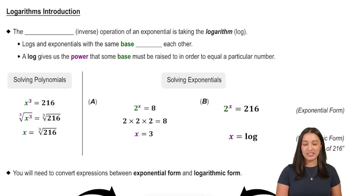
Logarithms are the inverse operations of exponentiation. The equation log₁₀ x = 3 means that 10 raised to the power of 3 equals x. Understanding logarithms is essential for solving equations involving them, as they help to express relationships between numbers in a more manageable form.
Recommended video:
7:30
Logarithms Introduction

Exponential Functions

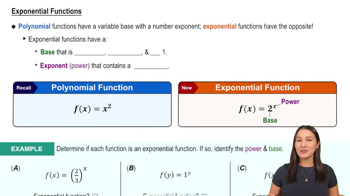
Exponential functions are mathematical functions of the form f(x) = a^x, where 'a' is a constant and 'x' is the variable. In the context of the logarithmic equation, recognizing that the logarithm represents an exponent allows us to convert the logarithmic form into an exponential form, facilitating the solution process.
Recommended video:
6:13
Exponential Functions

Properties of Logarithms

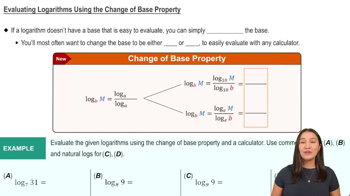
Properties of logarithms, such as the product, quotient, and power rules, provide tools for simplifying and manipulating logarithmic expressions. While not directly needed for this specific equation, understanding these properties can be crucial for solving more complex logarithmic equations and for combining multiple logarithmic terms.
Recommended video:
05:36
Change of Base Property