Ch. 4 - Applications of Derivatives
Hass - Thomas' Calculus 15th Edition
Hass15th EditionThomas' CalculusISBN: 9780137616077Not the one you use?Change textbook
Chapter 4, Problem 4.1.15

Finding Extrema from Graphs


In Exercises 15–20, sketch the graph of each function and determine whether the function has any absolute extreme values on its domain. Explain how your answer is consistent with Theorem 1.


f(x) = |x|, −1 < x < 2

Verified step by step guidance
1
Step 1: Begin by understanding the function f(x) = |x|, which represents the absolute value function. The graph of f(x) = |x| is a V-shaped graph with its vertex at the origin (0,0). However, we need to consider the domain given: -1 < x < 2.
Step 2: Sketch the graph of f(x) = |x| within the specified domain. Since the domain is -1 < x < 2, the graph will start just to the right of x = -1 and end just before x = 2. The vertex of the graph at (0,0) will be included in this domain.
Step 3: Identify the behavior of the graph within the domain. As x approaches -1 from the right, the function value approaches 1, and as x approaches 2 from the left, the function value approaches 2. The graph is symmetric about the y-axis, and the lowest point within the domain is at the vertex (0,0) where f(x) = 0.
Step 4: Determine the absolute extrema. The absolute minimum value of f(x) within the domain -1 < x < 2 is at x = 0, where f(x) = 0. There is no absolute maximum value because the function value increases indefinitely as x approaches 2 from the left.
Step 5: Relate your findings to Theorem 1, which states that a continuous function on a closed interval [a, b] has both an absolute maximum and minimum. However, the interval -1 < x < 2 is not closed, so the theorem does not apply directly. The function has an absolute minimum at x = 0 but no absolute maximum within the open interval.

Verified video answer for a similar problem:

This video solution was recommended by our tutors as helpful for the problem above.
Video duration:
6m
Was this helpful?

Key Concepts

Here are the essential concepts you must grasp in order to answer the question correctly.

Absolute Extrema

Absolute extrema refer to the highest or lowest points on a function's graph over a specified domain. An absolute maximum is the highest point, while an absolute minimum is the lowest. To find these, one must evaluate the function at critical points and endpoints within the domain, if they exist.
Recommended video:
05:58
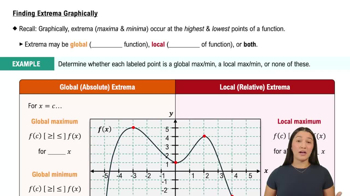
Finding Extrema Graphically

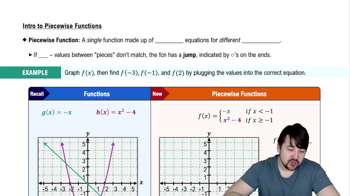
Graphing Piecewise Functions

Graphing piecewise functions involves plotting different expressions over specified intervals. For f(x) = |x|, the graph is a V-shape, with the vertex at the origin. Understanding how to sketch this graph helps in visualizing where potential extrema might occur within the given domain.
Recommended video:
05:36
Piecewise Functions

Theorem 1 (Extreme Value Theorem)

The Extreme Value Theorem states that if a function is continuous on a closed interval, it must have both a maximum and minimum value on that interval. However, since the domain here is open (-1, 2), the theorem does not directly apply, necessitating a careful analysis of the function's behavior near the endpoints.
Recommended video:
06:11
Fundamental Theorem of Calculus Part 1