Mean Value Theorem and graphs Find all points on the interval (1,3) at which the slope of the tangent line equals the average rate of change of f on [1,3]. Reconcile your results with the Mean Value Theorem. <IMAGE>
Ch. 4 - Applications of the Derivative
Briggs3rd EditionCalculus: Early TranscendentalsISBN: 9780136847243Not the one you use?Change textbook
Chapter 4, Problem 4.5.33
Maximum-volume cone A cone is constructed by cutting a sector from a circular sheet of metal with radius 20. The cut sheet is then folded up and welded (see figure). Find the radius and height of the cone with maximum volume that can be formed in this way. <IMAGE>
Verified step by step guidance1
Start by understanding the relationship between the original circle and the cone. The radius of the original circle is 20, and the arc length of the sector becomes the circumference of the base of the cone.
Let the angle of the sector be θ (in radians). The arc length of the sector is given by the formula: arc length = 20θ. This arc length is equal to the circumference of the base of the cone, which is 2πr, where r is the radius of the cone's base.
Set up the equation for the circumference: 20θ = 2πr. Solve for r in terms of θ: r = (20θ)/(2π).
The slant height of the cone is the radius of the original circle, which is 20. Use the Pythagorean theorem to express the height h of the cone in terms of r and the slant height: h = √(20² - r²).
The volume V of the cone is given by the formula: V = (1/3)πr²h. Substitute the expressions for r and h in terms of θ into this volume formula. Differentiate the volume with respect to θ, set the derivative equal to zero, and solve for θ to find the angle that maximizes the volume. Use this θ to find the corresponding r and h.

Verified video answer for a similar problem:
This video solution was recommended by our tutors as helpful for the problem above.
Video duration:
12mWas this helpful?
Key Concepts
Here are the essential concepts you must grasp in order to answer the question correctly.
Volume of a Cone
The volume of a cone is calculated using the formula V = (1/3)πr²h, where r is the radius of the base and h is the height. Understanding this formula is crucial for determining how changes in the radius and height affect the overall volume of the cone formed from the sector.
Recommended video:
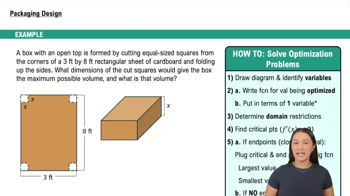
Example 5: Packaging Design
Optimization
Optimization in calculus involves finding the maximum or minimum values of a function. In this context, we need to maximize the volume of the cone by adjusting the radius and height, which requires setting up a function and using techniques such as differentiation to find critical points.
Recommended video:
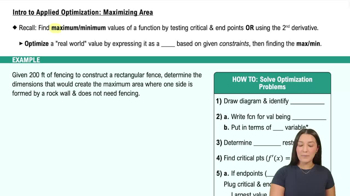
Intro to Applied Optimization: Maximizing Area
Geometric Relationships
Geometric relationships help us understand how the dimensions of the cone relate to the original circular sector. Specifically, the radius of the base of the cone and the height are influenced by the angle of the sector cut from the circle, which must be considered when formulating the volume equation.
Recommended video:
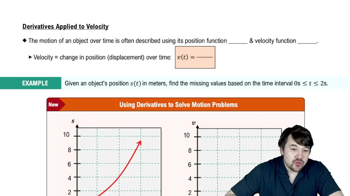
Derivatives Applied To Velocity
Related Practice
Textbook Question
281
views
Textbook Question
Minimum sum Find positive numbers x and y satisfying the equation xy = 12 such that the sum 2x + y is as small as possible.
205
views
Textbook Question
If F(x) = x² - 3x + C and F (-1) = 4 , what is the value of C?
39
views
Textbook Question
17–83. Limits Evaluate the following limits. Use l’Hôpital’s Rule when it is convenient and applicable.
lim_x→ -1 (x³ - x² - 5x - 3)/(x⁴ + 2x³ - x² -4x -2)
233
views
Textbook Question
17–83. Limits Evaluate the following limits. Use l’Hôpital’s Rule when it is convenient and applicable.
lim_x→ π/2⁻ (tanx ) / (3 / (2x - π))
219
views
Textbook Question
Differentials Consider the following functions and express the relationship between a small change in x and the corresponding change in y in the form dy = f'(x)dx.
f(x) = (x+4)/(4-x)
261
views