

Ch. 4 - Applications of Derivatives
Hass - Thomas' Calculus 15th Edition
Hass15th EditionThomas' CalculusISBN: 9780137616077Not the one you use?Change textbook
Chapter 4, Problem 50

In Exercises 49–52, graph each function. Then use the function’s first derivative to explain what you see.
y = 𝓍²/³ + (𝓍―1)²/³ 

Verified step by step guidance
1
First, understand the function y = x^(2/3) + (x - 1)^(2/3). This function is composed of two terms, each raised to the power of 2/3, which indicates that the function is continuous and smooth but may have points where the derivative is not defined.
To graph the function, identify key features such as intercepts and symmetry. The function is symmetric about the line x = 0.5 because both terms are even functions shifted by 1 unit.
Next, find the first derivative of the function to analyze its behavior. Use the power rule for derivatives: if f(x) = x^n, then f'(x) = n*x^(n-1). Apply this to each term: y' = (2/3)x^(-1/3) + (2/3)(x - 1)^(-1/3).
Determine the critical points by setting the first derivative equal to zero: (2/3)x^(-1/3) + (2/3)(x - 1)^(-1/3) = 0. Solve for x to find where the slope of the tangent is zero, indicating potential local maxima, minima, or points of inflection.
Analyze the sign of the first derivative around the critical points to determine intervals of increase and decrease. This will help explain the shape of the graph, such as where it is rising or falling, and confirm the presence of any local extrema.

Verified video answer for a similar problem:

This video solution was recommended by our tutors as helpful for the problem above.
Video duration:
9m
Was this helpful?

Key Concepts

Here are the essential concepts you must grasp in order to answer the question correctly.

Graphing Functions

Graphing functions involves plotting the set of points that satisfy the function's equation on a coordinate plane. For the function y = x^(2/3) + (x-1)^(2/3), understanding its shape and behavior requires identifying key features such as intercepts, symmetry, and any asymptotic behavior. This visual representation helps in analyzing the function's overall behavior and any critical points.
Recommended video:
5:53
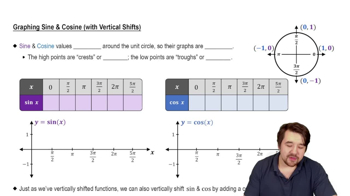
Graph of Sine and Cosine Function

First Derivative

The first derivative of a function, denoted as f'(x), provides information about the function's rate of change and can be used to determine intervals of increase or decrease. For y = x^(2/3) + (x-1)^(2/3), calculating the first derivative helps identify critical points where the slope is zero or undefined, indicating potential local maxima, minima, or points of inflection.
Recommended video:
07:09
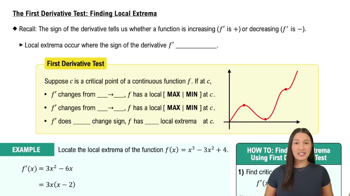
The First Derivative Test: Finding Local Extrema

Critical Points and Behavior Analysis

Critical points occur where the first derivative is zero or undefined, indicating potential changes in the function's behavior. Analyzing these points for y = x^(2/3) + (x-1)^(2/3) helps determine where the function changes from increasing to decreasing or vice versa. This analysis is crucial for understanding the graph's shape and identifying any local extrema or inflection points.
Recommended video:
04:50
Critical Points
Related Practice
Textbook Question

Each of Exercises 43–48 gives the first derivative of a function y = ƒ(𝓍). (a) At what points, if any, does the graph of ƒ have a local maximum, local minimum, or inflection point? (b) Sketch the general shape of the graph.

y' = 𝓍⁴ ― 2𝓍² 

213
views
Textbook Question

The range R of a projectile fired from the origin over horizontal ground is the distance from the origin to the point of impact. If the projectile is fired with an initial velocity at an angle with the horizontal, then in Chapter 13 we find that R-v_0^2/g(sin 2α) where g is the downward acceleration due to gravity. Find the angle α for which the range R is the largest possible.

242
views
Textbook Question

Sketch the graphs of the rational functions in Exercises 53–60.

y = (x2 + 1) / x                              

189
views
Textbook Question

In Exercises 9–66, graph the function using appropriate methods from the graphing procedures presented just before Example 9, identifying the coordinates of any local extreme points and inflection points. Then find coordinates of absolute extreme points, if any.

46. y = cos(x) + √3 * sin(x), 0 ≤ x ≤ 2π

175
views
Textbook Question

Sketch the graphs of the rational functions in Exercises 53–60.

y= (x + 1) / (x - 3)

228
views
Textbook Question

Applications


Classical accounts tell us that a 170-oar trireme (ancient Greek or Roman warship) once covered 184 sea miles in 24 hours. Explain why at some point during this feat the trireme’s speed exceeded 7.5 knots (sea or nautical miles per hour).

168
views