
Consider the position function s(t) =−16t^2+100t representing the position of an object moving vertically along a line. Sketch a graph of s with the secant line passing through (0.5, s(0.5)) and (2, s(2)). Determine the slope of the secant line and explain its relationship to the moving object.
Use analytical methods and/or a graphing utility to identify the vertical asymptotes (if any) of the following functions.
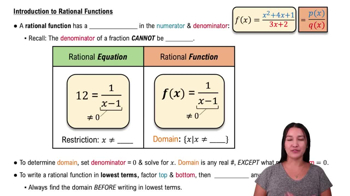
f(x)=x^2−3x+2 / x^10−x^9
Verified step by step guidance
Verified video answer for a similar problem:
Key Concepts
Vertical Asymptotes
Rational Functions
Factoring Polynomials
Sketch a graph of f and use it to make a conjecture about the values of f(a), lim x→a^−f(x),lim x→a^+f(x), and lim x→a f(x) or state that they do not exist.
f(x) = x^2+x−2 / x−1; a=1
Use the precise definition of infinite limits to prove the following limits.
Sketch a possible graph of a function g, together with vertical asymptotes, satisfying all the following conditions.
g(2) =1,g(5) =−1,lim x→4 g(x) =−∞,lim x→7^− g(x) =∞,lim x→7^+ g(x) =−∞
A sequence is an infinite, ordered list of numbers that is often defined by a function. For example, the sequence {2,4,6,8,…} is specified by the function f(n) = 2n, where n=1,2,3,….The limit of such a sequence is lim n→∞ f(n), provided the limit exists. All the limit laws for limits at infinity may be applied to limits of sequences. Find the limit of the following sequences or state that the limit does not exist.
{0,1/2,2/3,3/4,…}, which is defined by f(n) = (n−1) / n, for n=1,2,3,…
Use an appropriate limit definition to prove the following limits.
lim x→ 5x^2 − 25 / x − 5=10
