Find an equation of the straight line having slope 1/4 that is tangent to the curve y = √x.
Ch. 3 - Derivatives
Chapter 3, Problem 3.7.47
Theory and Examples
Intersecting normal line The line that is normal to the curve x² + 2xy – 3y² = 0 at (1,1) intersects the curve at what other point?
Verified step by step guidance1
First, find the derivative of the given implicit function \(x^2 + 2xy - 3y^2 = 0\) with respect to \(x\) using implicit differentiation. This will help us find the slope of the tangent line at any point \((x, y)\) on the curve.
Differentiate each term: \(\frac{d}{dx}(x^2) = 2x\), \(\frac{d}{dx}(2xy) = 2y + 2x\frac{dy}{dx}\), and \(\frac{d}{dx}(-3y^2) = -6y\frac{dy}{dx}\). Set the derivative equal to zero: \(2x + 2y + 2x\frac{dy}{dx} - 6y\frac{dy}{dx} = 0\).
Solve for \(\frac{dy}{dx}\) to find the slope of the tangent line: \(\frac{dy}{dx} = \frac{2x + 2y}{6y - 2x}\). Evaluate this derivative at the point \((1, 1)\) to find the slope of the tangent line at that point.
The slope of the normal line is the negative reciprocal of the tangent slope. Calculate this slope and use the point-slope form of a line equation \(y - y_1 = m(x - x_1)\) to find the equation of the normal line at \((1, 1)\).
Substitute the equation of the normal line into the original curve equation \(x^2 + 2xy - 3y^2 = 0\) to find the other point of intersection. Solve the resulting system of equations to find the coordinates of the other intersection point.

Verified video answer for a similar problem:
This video solution was recommended by our tutors as helpful for the problem above.
Video duration:
7mWas this helpful?
Key Concepts
Here are the essential concepts you must grasp in order to answer the question correctly.
Normal Line to a Curve
A normal line to a curve at a given point is perpendicular to the tangent line at that point. To find the equation of the normal line, first determine the slope of the tangent line using derivatives, then use the negative reciprocal of this slope for the normal line. This concept is crucial for understanding how the normal line interacts with the curve.
Recommended video:
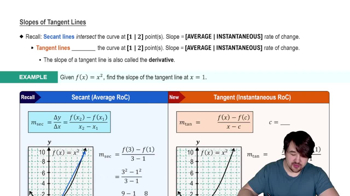
Slopes of Tangent Lines
Implicit Differentiation
Implicit differentiation is used when dealing with equations where y is not isolated. It involves differentiating both sides of the equation with respect to x, treating y as a function of x. This technique is essential for finding the derivative of the given curve x² + 2xy – 3y² = 0, which helps in determining the slope of the tangent line at a specific point.
Recommended video:
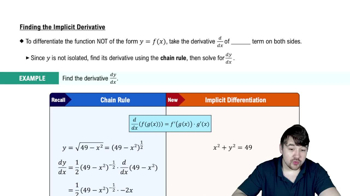
Finding The Implicit Derivative
Intersection of Curves
Finding the intersection of curves involves solving the equations of the curves simultaneously. After determining the equation of the normal line, substitute it back into the original curve equation to find other points of intersection. This concept is key to identifying where the normal line intersects the curve again, beyond the initial point of tangency.
Recommended video:
Finding Area Between Curves that Cross on the Interval
Related Practice
Textbook Question
225
views
Textbook Question
Find dy/dt when x = 1 if y = x² + 7x − 5 and dx/dt = ¹/₃.
295
views
Textbook Question
In Exercises 41–58, find dy/dt.
y = √(3t + (√2 + √(1 − t)))
288
views
Textbook Question
Finding Derivative Functions and Values
Using the definition, calculate the derivatives of the functions in Exercises 1–6. Then find the values of the derivatives as specified.
g(t) = 1/t²; g′(−1), g′(2), g′(√3)
227
views
Textbook Question
A growing sand pile Sand falls from a conveyor belt at the rate of 10 m³/min onto the top of a conical pile. The height of the pile is always three-eighths of the base diameter. How fast are the (a) height and (b) radius changing when the pile is 4 m high? Answer in centimeters per minute.
303
views
Textbook Question
If r + s² + v³ = 12, dr/dt = 4, and ds/dt = –3, find dv/dt when r = 3 and s = 1.
187
views