Ch. 3 - Derivatives
Briggs - Calculus: Early Transcendentals 3rd Edition
Briggs3rd EditionCalculus: Early TranscendentalsISBN: 9780136847243Not the one you use?Change textbook
Chapter 3, Problem 3.R.23

Evaluate and simplify y'.


y = ln |sec 3x|

Verified step by step guidance
1
Identify the given equation: y' * y = ln |sec(3x)|. This is a differential equation where y' is the derivative of y with respect to x.
Recognize that this is a separable differential equation. We can separate the variables y and x to solve it.
Rewrite the equation by dividing both sides by y: y' = (ln |sec(3x)|) / y.
Integrate both sides: Integrate the left side with respect to y and the right side with respect to x. The left side becomes ∫(1/y) dy, and the right side becomes ∫ln |sec(3x)| dx.
Solve the integrals: The integral of 1/y with respect to y is ln|y|, and the integral of ln |sec(3x)| with respect to x will require integration techniques such as integration by parts. After integrating, solve for y to find the general solution.

Verified video answer for a similar problem:

This video solution was recommended by our tutors as helpful for the problem above.
Video duration:
5m
Was this helpful?

Key Concepts

Here are the essential concepts you must grasp in order to answer the question correctly.

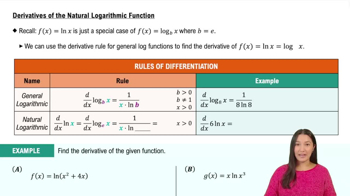
Derivative of Natural Logarithm

The derivative of the natural logarithm function, ln(x), is given by 1/x. When dealing with the natural logarithm of a function, such as ln|u|, the derivative is found using the chain rule, resulting in (1/u) * (du/dx). This principle is essential for differentiating functions involving logarithms.
Recommended video:
05:18
Derivative of the Natural Logarithmic Function

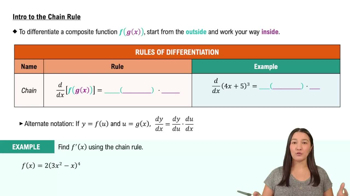
Chain Rule

The chain rule is a fundamental technique in calculus used to differentiate composite functions. It states that if a function y is composed of another function u, then the derivative dy/dx can be calculated as dy/du multiplied by du/dx. This rule is crucial when differentiating functions like ln|sec 3x|, where sec 3x is a composite function.
Recommended video:
05:02
Intro to the Chain Rule

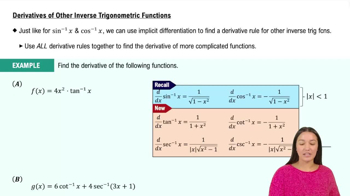
Trigonometric Derivatives

Understanding the derivatives of trigonometric functions is vital for calculus. For example, the derivative of sec(x) is sec(x)tan(x). In the context of the given function, knowing how to differentiate sec(3x) will be necessary to apply the chain rule effectively and find the derivative of y = ln|sec 3x|.
Recommended video:
06:35
Derivatives of Other Inverse Trigonometric Functions