
Ch. 1 - Functions
Briggs - Calculus: Early Transcendentals 3rd Edition
Briggs3rd EditionCalculus: Early TranscendentalsISBN: 9780136847243Not the one you use?Change textbook
Chapter 1, Problem 34

Composite functions and notation
Let ƒ(x)= x² - 4 , g(x) = x³ and F(x) = 1/(x-3).
Simplify or evaluate the following expressions.
F(y⁴)

Verified step by step guidance
1
Identify the function F(x) given as F(x) = \(\frac{1}{x-3}\).
Substitute y^4 for x in the function F(x) to find F(y^4).
This substitution gives F(y^4) = \(\frac{1}{y^4 - 3}\).
Simplify the expression if possible, but in this case, it is already in its simplest form.
Conclude that F(y^4) = \(\frac{1}{y^4 - 3}\) is the simplified expression.

Verified video answer for a similar problem:

This video solution was recommended by our tutors as helpful for the problem above.
Video duration:
1m
Was this helpful?

Key Concepts

Here are the essential concepts you must grasp in order to answer the question correctly.

Composite Functions

Composite functions are formed when one function is applied to the result of another function. In this case, if we have functions f and g, the composite function (f ∘ g)(x) means f(g(x)). Understanding how to evaluate composite functions is crucial for simplifying expressions like F(y⁴), where F is applied to the output of another function.
Recommended video:
3:48
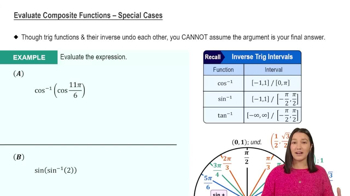
Evaluate Composite Functions - Special Cases

Function Notation

Function notation is a way to denote functions and their inputs clearly. For example, F(x) indicates that F is a function of x. In the expression F(y⁴), y⁴ is the input to the function F. Familiarity with function notation helps in correctly interpreting and manipulating expressions involving multiple functions.
Recommended video:
7:24
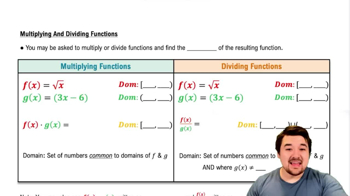
Multiplying & Dividing Functions

Simplification of Expressions

Simplification involves reducing an expression to its simplest form, making it easier to work with. This can include combining like terms, factoring, or substituting values. In the context of the given question, simplifying F(y⁴) requires substituting y⁴ into the function F and then performing any necessary algebraic operations to express the result in a more manageable form.
Recommended video:
6:36
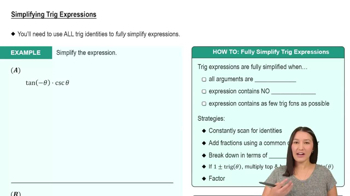
Simplifying Trig Expressions
Related Practice
Textbook Question

Draining a tank (Torricelli’s law) A cylindrical tank with a cross-sectional area of 1010 m2 is filled to a depth of 2525 m with water. At t=0t=0 s, a drain in the bottom of the tank with an area of 11  is opened, allowing water to flow out of the tank. The depth of water in the tank (in meters) at time t0t\(\geq{0}\) is d(t)=(50.22t)2d\(\left\)(t\(\right\))=\(\left\)(5-0.22t\(\right\))^2.

b. At what time is the tank empty?

511
views
Textbook Question

The graph of ƒ is shown in the figure. Graph the following functions. <IMAGE>

a. ƒ(x+1)ƒ( x + 1)

272
views
Textbook Question

Composite functions and notation

Let ƒ(x)= x² - 4 , g(x) = x³ and F(x) = 1/(x-3). Simplify or evaluate the following expressions.

g(1/z)

389
views
Textbook Question

Composite functions and notation

Let ƒ(x)= x² - 4 , g(x) = x³ and F(x) = 1/(x-3).

Simplify or evaluate the following expressions.

F(F(x))

269
views
Textbook Question

Composite functions and notation

Let ƒ(x)= x² - 4 , g(x) = x³ and F(x) = 1/(x-3).

Simplify or evaluate the following expressions.

F(g(y))

227
views
Textbook Question

Draining a tank (Torricelli’s law) A cylindrical tank with a cross-sectional area of 1010 m2 is filled to a depth of 2525 m with water. At t=0t=0 s, a drain in the bottom of the tank with an area of 11  is opened, allowing water to flow out of the tank. The depth of water in the tank (in meters) at time t0t\(\geq{0}\) is d(t)=(50.22t)2d\(\left\)(t\(\right\))=\(\left\)(5-0.22t\(\right\))^2.

c. What is an appropriate domain for dd?

319
views