Ch. 2 - Limits and Continuity
Hass - Thomas' Calculus 15th Edition
Hass15th EditionThomas' CalculusISBN: 9780137616077Not the one you use?Change textbook
Chapter 2, Problem 2.2.68a

Estimating Limits


[Technology Exercise] You will find a graphing calculator useful for Exercises 67–74.


Let g(x) = (x² − 2) / (x − √2)


a. Make a table of the values of g at the points x=1.4,1.41,1.414, and so on through successive decimal approximations of √2. Estimate limx→√2 g(x).

Verified step by step guidance
1
Identify the function g(x) = (x² − 2) / (x − √2) and recognize that the limit we are estimating is as x approaches √2.
Create a table of values for g(x) at points that are close to √2, such as x = 1.4, 1.41, 1.414, etc. These values are chosen because they are successive decimal approximations of √2.
For each value of x, substitute it into the function g(x) to calculate the corresponding value of g(x). This involves evaluating the expression (x² − 2) / (x − √2) for each x.
Observe the trend in the values of g(x) as x gets closer to √2. This will help in estimating the limit.
Based on the trend observed in the table, make an educated estimate of limx→√2 g(x). The goal is to determine what value g(x) approaches as x gets infinitely close to √2.

Verified video answer for a similar problem:

This video solution was recommended by our tutors as helpful for the problem above.
Video duration:
3m
Was this helpful?

Key Concepts

Here are the essential concepts you must grasp in order to answer the question correctly.

Limits

A limit is a fundamental concept in calculus that describes the behavior of a function as its input approaches a certain value. It helps in understanding how functions behave near points of interest, including points where they may not be defined. For example, the limit of g(x) as x approaches √2 allows us to analyze the function's value even though g(√2) is undefined due to division by zero.
Recommended video:
05:50
One-Sided Limits

Continuous Functions

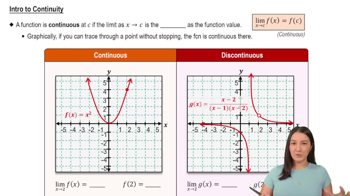
A function is continuous at a point if the limit of the function as it approaches that point equals the function's value at that point. Understanding continuity is crucial when estimating limits, as it indicates that small changes in x will result in small changes in g(x). If g(x) is continuous around √2, we can confidently estimate the limit using values close to √2.
Recommended video:
05:34
Intro to Continuity

Table of Values

Creating a table of values involves calculating the function's output for various inputs, which helps visualize the function's behavior near a specific point. In this exercise, evaluating g(x) at points approaching √2 allows for a numerical estimation of the limit. This method is particularly useful when the function is complex or when direct substitution is not possible.
Recommended video:
06:37
Average Value of a Function