
Ch. 4 - Applications of Derivatives
Hass - Thomas' Calculus 15th Edition
Hass15th EditionThomas' CalculusISBN: 9780137616077Not the one you use?Change textbook
Chapter 4, Problem 4.5.10

10. Catching rainwater A 1125 ft^3 open-top rectangular tank with a square base x ft on a side and y ft deep is to be built with its top flush with the ground to catch runoff water. The costs associated with the tank involve not only the material from which the tank is made but also an excavation charge proportional to the product xy.
a. If the total cost is c=5(x^2+4xy) + 10xy, what values of x and y will minimize it?
b. Give a possible scenario for the cost function in part (a).

Verified step by step guidance
1
Step 1: Understand the problem. We need to minimize the cost function c = 5(x^2 + 4xy) + 10xy, where x is the side length of the square base and y is the depth of the tank. The volume of the tank is given as 1125 ft^3, which provides a constraint: x^2 * y = 1125.
Step 2: Express y in terms of x using the volume constraint. From x^2 * y = 1125, solve for y to get y = 1125 / x^2.
Step 3: Substitute y = 1125 / x^2 into the cost function c. This gives c = 5(x^2 + 4x(1125 / x^2)) + 10x(1125 / x^2). Simplify this expression to get a function of x only.
Step 4: Differentiate the cost function with respect to x to find the critical points. Set the derivative equal to zero and solve for x. This will give the value of x that minimizes the cost.
Step 5: Use the second derivative test to confirm that the critical point found is indeed a minimum. Then, substitute the value of x back into y = 1125 / x^2 to find the corresponding value of y.

Verified video answer for a similar problem:

This video solution was recommended by our tutors as helpful for the problem above.
Video duration:
7m
Was this helpful?

Key Concepts

Here are the essential concepts you must grasp in order to answer the question correctly.

Optimization in Calculus

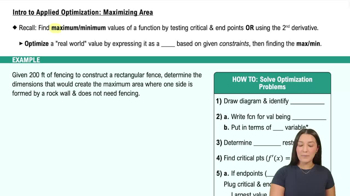
Optimization involves finding the maximum or minimum values of a function within a given domain. In this problem, the goal is to minimize the cost function c = 5(x^2 + 4xy) + 10xy, which represents the total cost of building the tank. This requires using techniques such as setting the derivative of the cost function to zero to find critical points and determining which of these points yields the minimum cost.
Recommended video:
10:13
Intro to Applied Optimization: Maximizing Area

Partial Derivatives

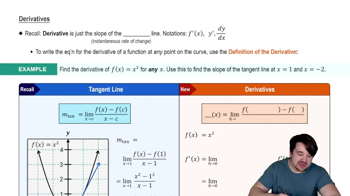
Partial derivatives are used to analyze functions of multiple variables, like c(x, y) in this problem. They measure how the function changes as one variable changes while keeping others constant. To minimize the cost function, we need to find the partial derivatives with respect to x and y, set them to zero, and solve the resulting system of equations to find the values of x and y that minimize the cost.
Recommended video:
05:44
Derivatives

Critical Points and Second Derivative Test

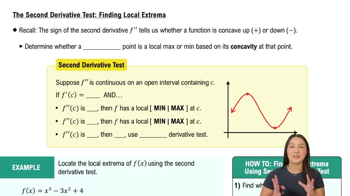
Critical points occur where the first derivative (or partial derivatives) of a function is zero or undefined. To determine if these points are minima, maxima, or saddle points, the second derivative test is used. For functions of two variables, this involves evaluating the Hessian matrix at the critical points. If the Hessian is positive definite, the point is a local minimum, which is crucial for confirming the minimum cost configuration in this scenario.
Recommended video:
06:02
The Second Derivative Test: Finding Local Extrema