Ch. 2 - Limits and Continuity
Hass - Thomas' Calculus 15th Edition
Hass15th EditionThomas' CalculusISBN: 9780137616077Not the one you use?Change textbook
Chapter 2, Problem 2.4.55

Formal Definitions of One-Sided Limits


Greatest integer function Find (a) limx→400+ ⌊x⌋ and (b) limx→400− ⌊x⌋; then use limit definitions to verify your findings. (c) Based on your conclusions in parts (a) and (b), can you say anything about limx→400 ⌊x⌋? Give reasons for your answer.

Verified step by step guidance
1
Understand the greatest integer function, denoted as ⌊x⌋, which returns the largest integer less than or equal to x. For example, ⌊3.7⌋ = 3 and ⌊-2.3⌋ = -3.
To find (a) limx→400+ ⌊x⌋, consider values of x that are slightly greater than 400, such as 400.1, 400.01, etc. For these values, ⌊x⌋ will be 400 because the greatest integer less than or equal to any number slightly greater than 400 is 400.
To find (b) limx→400- ⌊x⌋, consider values of x that are slightly less than 400, such as 399.9, 399.99, etc. For these values, ⌊x⌋ will be 399 because the greatest integer less than or equal to any number slightly less than 400 is 399.
Verify the findings using the formal definition of one-sided limits: For (a), for every ε > 0, there exists a δ > 0 such that if 400 < x < 400 + δ, then |⌊x⌋ - 400| < ε. For (b), for every ε > 0, there exists a δ > 0 such that if 400 - δ < x < 400, then |⌊x⌋ - 399| < ε.
For (c), since the one-sided limits from parts (a) and (b) are not equal (400 ≠ 399), the two-sided limit limx→400 ⌊x⌋ does not exist. This is because a two-sided limit exists only if both one-sided limits are equal.

Verified video answer for a similar problem:

This video solution was recommended by our tutors as helpful for the problem above.
Video duration:
3m
Was this helpful?

Key Concepts

Here are the essential concepts you must grasp in order to answer the question correctly.

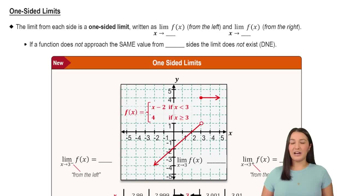
One-Sided Limits

One-sided limits refer to the behavior of a function as the input approaches a specific value from one side only. The right-hand limit, denoted as lim x→c+, considers values approaching c from the right (greater than c), while the left-hand limit, lim x→c−, considers values approaching c from the left (less than c). Understanding one-sided limits is crucial for analyzing functions that may have different behaviors depending on the direction of approach.
Recommended video:
05:50
One-Sided Limits

Greatest Integer Function

The greatest integer function, denoted as ⌊x⌋, returns the largest integer less than or equal to x. This function is piecewise constant, meaning it remains constant over intervals between integers and jumps at each integer value. Recognizing how this function behaves near integer values is essential for evaluating limits, especially when approaching from either side of an integer.
Recommended video:
6:04
Intro to Rational Functions

Limit Definitions and Continuity

Limit definitions provide a formal way to determine the value that a function approaches as the input approaches a certain point. A function is continuous at a point if the limit from both sides equals the function's value at that point. In the context of the greatest integer function, analyzing one-sided limits helps determine whether the overall limit exists and whether the function is continuous at that point, which is critical for drawing conclusions about its behavior.
Recommended video:
05:43
Definition of the Definite Integral