Ch. 4 - Applications of the Derivative
Briggs - Calculus: Early Transcendentals 3rd Edition
Briggs3rd EditionCalculus: Early TranscendentalsISBN: 9780136847243Not the one you use?Change textbook
Chapter 4, Problem 4.6.69

Differentials Consider the following functions and express the relationship between a small change in x and the corresponding change in y in the form dy = f'(x)dx.


f(x) = tan x

Verified step by step guidance
1
First, understand that the differential dy represents the change in the function's output, while dx represents a small change in the input x.
To find the relationship between dy and dx, we need to compute the derivative of the function f(x) = tan(x).
Recall that the derivative of tan(x) with respect to x is sec^2(x). This is a standard derivative result.
Express the differential relationship using the formula dy = f'(x)dx. Substitute f'(x) with sec^2(x) to get dy = sec^2(x)dx.
This equation, dy = sec^2(x)dx, shows how a small change in x (dx) affects the change in y (dy) for the function f(x) = tan(x).

Verified video answer for a similar problem:

This video solution was recommended by our tutors as helpful for the problem above.
Video duration:
2m
Was this helpful?

Key Concepts

Here are the essential concepts you must grasp in order to answer the question correctly.

Differentials

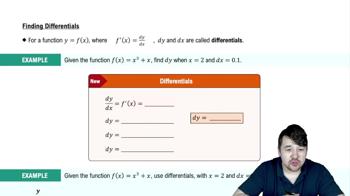
Differentials represent the infinitesimal changes in variables. In calculus, if y = f(x), the differential dy is defined as dy = f'(x)dx, where f'(x) is the derivative of f with respect to x. This relationship allows us to approximate how a small change in x (denoted as dx) affects the change in y (denoted as dy).
Recommended video:
05:53
Finding Differentials

Derivatives

The derivative of a function at a point measures the rate at which the function's value changes as its input changes. It is defined as the limit of the average rate of change of the function as the interval approaches zero. For the function f(x) = tan x, the derivative f'(x) can be calculated using differentiation rules, which will be essential for expressing dy in terms of dx.
Recommended video:
05:44
Derivatives

Chain Rule

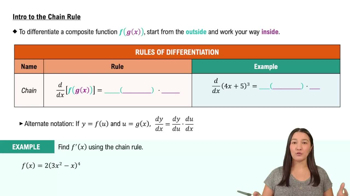
The chain rule is a fundamental theorem in calculus used to differentiate composite functions. It states that if a function y = f(g(x)) is composed of two functions, the derivative can be found by multiplying the derivative of the outer function by the derivative of the inner function. Understanding the chain rule is crucial when dealing with functions like f(x) = tan x, especially when applying it to find the relationship between dx and dy.
Recommended video:
05:02
Intro to the Chain Rule