Ch. 2 - Limits and Continuity
Hass - Thomas' Calculus 15th Edition
Hass15th EditionThomas' CalculusISBN: 9780137616077Not the one you use?Change textbook
Chapter 2, Problem 2.5.54

A function value Show that the function F(x) = ( x − a)²(x − b)² + x takes on the value (a + b)² for some value of x.

Verified step by step guidance
1
First, understand that we need to show that the function \( F(x) = (x - a)^2(x - b)^2 + x \) takes on the value \( (a + b)^2 \) for some value of \( x \). This means we need to find \( x \) such that \( F(x) = (a + b)^2 \).
Set the equation \( (x - a)^2(x - b)^2 + x = (a + b)^2 \) and rearrange it to form a new equation: \( (x - a)^2(x - b)^2 + x - (a + b)^2 = 0 \).
Consider this as a new function \( G(x) = (x - a)^2(x - b)^2 + x - (a + b)^2 \). We need to find the roots of \( G(x) \), i.e., values of \( x \) for which \( G(x) = 0 \).
Analyze the behavior of \( G(x) \) by considering its derivative \( G'(x) \) to find critical points, which might help in identifying where \( G(x) \) changes sign or equals zero.
Evaluate \( G(x) \) at specific points or use the Intermediate Value Theorem, which states that if \( G(x) \) is continuous on an interval \([c, d]\) and \( G(c) \) and \( G(d) \) have opposite signs, then there exists at least one \( x \) in \( (c, d) \) such that \( G(x) = 0 \). This will help confirm the existence of such an \( x \).

Verified video answer for a similar problem:

This video solution was recommended by our tutors as helpful for the problem above.
Video duration:
5m
Was this helpful?

Key Concepts

Here are the essential concepts you must grasp in order to answer the question correctly.

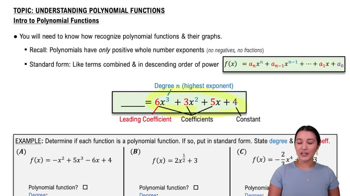
Polynomial Functions

A polynomial function is a mathematical expression involving a sum of powers in one or more variables multiplied by coefficients. In this case, F(x) is a polynomial of degree four, which means it can have up to four roots. Understanding the behavior of polynomial functions, including their continuity and the Intermediate Value Theorem, is essential for analyzing the function's values.
Recommended video:
6:04
Introduction to Polynomial Functions

Roots and Values of Functions

The roots of a function are the values of x for which the function equals zero. To show that F(x) takes on the value (a + b)², we need to analyze the function's behavior and find specific x-values that yield this output. This involves setting up the equation F(x) = (a + b)² and determining if there are solutions within the domain of the function.
Recommended video:
06:37
Average Value of a Function

The Intermediate Value Theorem

The Intermediate Value Theorem states that if a function is continuous on a closed interval [c, d], then it takes on every value between F(c) and F(d). This theorem is crucial for proving that F(x) achieves the value (a + b)², as it allows us to conclude that if F(c) < (a + b)² < F(d) for some c and d, then there exists at least one x in (c, d) such that F(x) = (a + b)².
Recommended video:
06:11
Fundamental Theorem of Calculus Part 1