Ch. 3 - Derivatives
Briggs - Calculus: Early Transcendentals 3rd Edition
Briggs3rd EditionCalculus: Early TranscendentalsISBN: 9780136847243Not the one you use?Change textbook
Chapter 3, Problem 3.8.64b

Vertical tangent lines
b. Does the curve have any horizontal tangent lines? Explain.

Verified step by step guidance
1
To determine if the curve has any horizontal tangent lines, we need to find where the derivative of the function is equal to zero. Horizontal tangent lines occur at points where the slope of the curve is zero.
First, identify the function that describes the curve. Let's denote this function as f(x).
Next, compute the derivative of the function, f'(x), using differentiation rules. This derivative represents the slope of the tangent line at any point x on the curve.
Set the derivative f'(x) equal to zero and solve for x. This will give you the x-values where the slope of the tangent line is zero, indicating potential horizontal tangent lines.
Finally, verify these x-values by substituting them back into the original function f(x) to find the corresponding y-values. This will confirm the points on the curve where horizontal tangent lines occur.

Verified video answer for a similar problem:

This video solution was recommended by our tutors as helpful for the problem above.
Video duration:
3m
Was this helpful?

Key Concepts

Here are the essential concepts you must grasp in order to answer the question correctly.

Tangent Lines

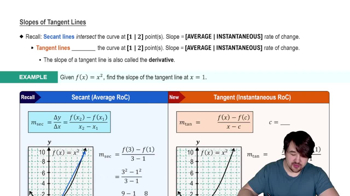
Tangent lines are straight lines that touch a curve at a single point without crossing it. The slope of the tangent line at a point on the curve represents the instantaneous rate of change of the function at that point. Understanding tangent lines is crucial for analyzing the behavior of curves, particularly in determining where they are increasing or decreasing.
Recommended video:
05:13
Slopes of Tangent Lines

Vertical Tangent Lines

A vertical tangent line occurs when the slope of the tangent approaches infinity, which typically happens when the derivative of the function is undefined at that point. This can indicate a cusp or a vertical asymptote in the curve. Identifying vertical tangents is important for understanding the limits and behavior of the function near those points.
Recommended video:
05:13
Slopes of Tangent Lines

Horizontal Tangent Lines

A horizontal tangent line occurs when the slope of the tangent line is zero, indicating that the function has a local maximum or minimum at that point. To find horizontal tangents, one must set the derivative of the function equal to zero and solve for the corresponding x-values. This concept is essential for analyzing critical points and the overall shape of the curve.
Recommended video:
05:13
Slopes of Tangent Lines