Ch. 4 - Applications of the Derivative
Briggs - Calculus: Early Transcendentals 3rd Edition
Briggs3rd EditionCalculus: Early TranscendentalsISBN: 9780136847243Not the one you use?Change textbook
Chapter 4, Problem 4.6.68

Differentials Consider the following functions and express the relationship between a small change in x and the corresponding change in y in the form dy = f'(x)dx.


f(x) = sin⁻¹ x

Verified step by step guidance
1
First, understand that the problem is asking for the differential dy in terms of dx for the function f(x) = sin⁻¹(x). The differential dy represents the change in y corresponding to a small change in x, denoted as dx.
To find dy, we need to determine the derivative of the function f(x) = sin⁻¹(x) with respect to x. The derivative of sin⁻¹(x) is given by f'(x) = \( \frac{1}{\sqrt{1-x^2}} \).
Now, express the differential dy in terms of dx using the formula dy = f'(x)dx. Substitute the derivative we found into this formula.
This gives us dy = \( \frac{1}{\sqrt{1-x^2}} \) dx. This equation shows how a small change in x (dx) affects the change in y (dy) for the function f(x) = sin⁻¹(x).
Finally, remember that this relationship is valid for values of x within the domain of the inverse sine function, which is -1 ≤ x ≤ 1. This ensures that the expression under the square root is non-negative.

Verified video answer for a similar problem:

This video solution was recommended by our tutors as helpful for the problem above.
Video duration:
2m
Was this helpful?

Key Concepts

Here are the essential concepts you must grasp in order to answer the question correctly.

Differentials

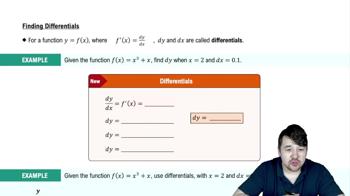
Differentials represent the infinitesimal changes in variables. In calculus, if y is a function of x, the differential dy is defined as the product of the derivative f'(x) and the differential dx, which represents a small change in x. This relationship helps in approximating how a small change in x affects the change in y.
Recommended video:
05:53
Finding Differentials

Derivative

The derivative of a function at a point measures the rate at which the function's value changes as its input changes. It is denoted as f'(x) and is calculated as the limit of the average rate of change of the function as the interval approaches zero. In the context of differentials, the derivative provides the necessary slope to relate changes in x and y.
Recommended video:
05:44
Derivatives

Inverse Function

An inverse function reverses the effect of the original function. For example, the inverse of f(x) = sin(x) is f⁻¹(x) = sin⁻¹(x), which takes a value from the range of the sine function and returns the corresponding angle. Understanding inverse functions is crucial when dealing with their derivatives, as the derivative of an inverse function can be found using the formula f⁻¹'(y) = 1 / f'(x) where y = f(x).
Recommended video:
4:49
Inverse Cosine
Related Practice
Textbook Question

Evaluate the following limits. Use l’Hôpital’s Rule when it is convenient and applicable.

lim_x→π/2⁻ (π - 2x) tan x  

164
views

Textbook Question

Shipping crates A square-based, box-shaped shipping crate is designed to have a volume of 16 ft³. The material used to make the base costs twice as much (per square foot) as the material in the sides, and the material used to make the top costs half as much (per square foot) as the material in the sides. What are the dimensions of the crate that minimize the cost of materials?

286
views
Textbook Question

{Use of Tech} Special curves The following classical curves have been studied by generations of mathematicians. Use analytical methods (including implicit differentiation) and a graphing utility to graph the curves. Include as much detail as possible.


x³ + y³ = 3xy (Folium of Descartes)

162
views
Textbook Question

Snell’s Law Suppose a light source at A is in a medium in which light travels at a speed v₁ and that point B is in a medium in which light travels at a speed v₂ (see figure). Using Fermat’s Principle, which states that light travels along the path that requires the minimum travel time (Exercise 55), show that the path taken between points A and B satisfies (sinΘ₁/v₁ = (sin Θ₂) /v₂ . <IMAGE>

291
views
Textbook Question

Evaluate the following limits. Use l’Hôpital’s Rule when it is convenient and applicable.


lim_x→ 1 (x² + 2x) / (x +3)

271
views
Textbook Question

23–68. Indefinite integrals Determine the following indefinite integrals. Check your work by differentiation.


∫ (sec² x - 1) dx

90
views