Ch. 1 - Functions
Briggs - Calculus: Early Transcendentals 3rd Edition
Briggs3rd EditionCalculus: Early TranscendentalsISBN: 9780136847243Not the one you use?Change textbook
Chapter 1, Problem 17

Find the linear function whose graph passes through the point (3, 2) and is parallel to the line y=3x+8y= 3x + 8 .

Verified step by step guidance
1
Identify the slope of the given line, which is parallel to the line we need to find. The given line is \( y = 3x + 8 \), so the slope \( m \) is 3.
Use the point-slope form of a linear equation, which is \( y - y_1 = m(x - x_1) \), where \( (x_1, y_1) \) is a point on the line and \( m \) is the slope.
Substitute the point \( (3, 2) \) and the slope \( m = 3 \) into the point-slope form: \( y - 2 = 3(x - 3) \).
Simplify the equation to get it into the slope-intercept form \( y = mx + b \).
Distribute the 3 on the right side: \( y - 2 = 3x - 9 \), then add 2 to both sides to solve for \( y \).

Verified video answer for a similar problem:

This video solution was recommended by our tutors as helpful for the problem above.
Video duration:
4m
Was this helpful?

Key Concepts

Here are the essential concepts you must grasp in order to answer the question correctly.

Linear Functions

A linear function is a mathematical expression that describes a straight line when graphed. It is typically represented in the form y = mx + b, where m is the slope and b is the y-intercept. Understanding linear functions is crucial for determining the relationship between variables and for solving problems involving lines.
Recommended video:
07:17
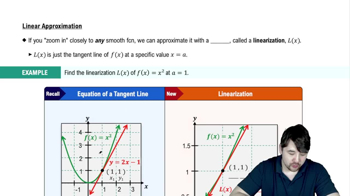
Linearization

Slope

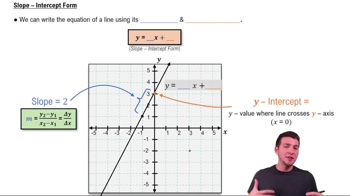
The slope of a line measures its steepness and direction, calculated as the change in y divided by the change in x (rise over run). For two parallel lines, the slopes are equal. In this question, the slope of the given line y = 3x + 8 is 3, which will be the same for the linear function we need to find.
Recommended video:
Guided course
3:56
Slope-Intercept Form

Point-Slope Form

The point-slope form of a linear equation is expressed as y - y1 = m(x - x1), where (x1, y1) is a specific point on the line and m is the slope. This form is particularly useful for writing the equation of a line when you know a point on the line and its slope, allowing for straightforward calculations in this problem.
Recommended video:
Guided course
3:56
Slope-Intercept Form
Related Practice
Textbook Question

Composite functions

Let ƒ(x) = x³, g (x) = sin x and h(x) = √x .

Evaluate h(g( π/2)).

356
views

Textbook Question

Use the table to evaluate the given compositions. <IMAGE>


ƒ(ƒ(h(3)))

391
views
Textbook Question

Evaluating trigonometric functions Without using a calculator, evaluate the following expressions or state that the quantity is undefined.


cos (2π/3)

267
views
Textbook Question

Use the table to evaluate the given compositions. <IMAGE>


h(h(h(0)))

337
views
Textbook Question

Yeast growth Consider a colony of yeast cells that has the shape of a cylinder. As the number of yeast cells increases, the cross-sectional area A (in mm²) of the colony increases but the height of the colony remains constant. If the colony starts from a single cell, the number of yeast cells (in millions) is approximated by the linear function N(A) - CₛA, where the constant Cₛ is known as the cell-surface coefficient. Use the given information to determine the cell-surface coefficient for each of the following colonies of yeast cells, and find the number of yeast cells in the colony when the cross-sectional area A reaches 150 mm². (Source: Letters in Applied Microbiology, 594, 59, 2014)

The scientific name of baker’s or brewer’s yeast (used in making bread, wine, and beer) is Saccharomyces cerevisiae. When the cross-sectional area of a colony of this yeast reaches 100 mm², there are 571 million yeast cells.

236
views
Textbook Question

Use the table to evaluate the given compositions. <IMAGE>


g(ƒ(h(4)))

300
views