
Ch. 4 - Applications of Derivatives
Hass - Thomas' Calculus 15th Edition
Hass15th EditionThomas' CalculusISBN: 9780137616077Not the one you use?Change textbook
Chapter 4, Problem 63

An isosceles triangle has its vertex at the origin and its base parallel to the x-axis with the vertices above the axis on the curve y = 27 - x2. Find the largest area the triangle can have.

Verified step by step guidance
1
Identify the vertices of the isosceles triangle. The vertex is at the origin (0,0), and the base is parallel to the x-axis. The other two vertices are on the curve y = 27 - x^2, so they are at points (x, 27 - x^2) and (-x, 27 - x^2).
Express the base length of the triangle. The base of the triangle is the distance between the points (x, 27 - x^2) and (-x, 27 - x^2), which is 2x.
Determine the height of the triangle. The height is the y-coordinate of the points on the curve, which is 27 - x^2.
Write the formula for the area of the triangle. The area A of a triangle is given by A = 1/2 * base * height. Substitute the expressions for the base and height: A = 1/2 * 2x * (27 - x^2).
Maximize the area function. Simplify the area expression to A = x * (27 - x^2) and find the derivative dA/dx. Set the derivative equal to zero to find critical points, and use the second derivative test or analyze the critical points to determine the maximum area.

Verified video answer for a similar problem:

This video solution was recommended by our tutors as helpful for the problem above.
Video duration:
5m
Was this helpful?

Key Concepts

Here are the essential concepts you must grasp in order to answer the question correctly.

Area of a Triangle

The area of a triangle can be calculated using the formula A = 1/2 * base * height. In this context, the base of the isosceles triangle is determined by the x-coordinates of its vertices, while the height is the y-coordinate of the vertex at the origin. Understanding how to express the area in terms of these variables is crucial for maximizing it.
Recommended video:
05:06
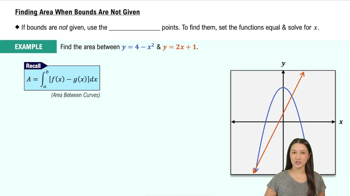
Finding Area When Bounds Are Not Given

Quadratic Functions

The curve y = 27 - x² is a downward-opening parabola, which is a type of quadratic function. This function's maximum point occurs at its vertex, which is essential for determining the height of the triangle. Recognizing the properties of quadratic functions helps in analyzing the relationship between the triangle's dimensions and the curve.
Recommended video:
6:04
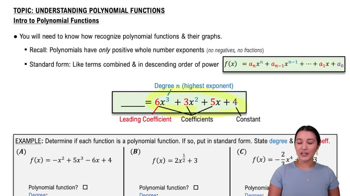
Introduction to Polynomial Functions

Optimization

Optimization in calculus involves finding the maximum or minimum values of a function. In this problem, we need to maximize the area of the triangle, which requires setting up a function for the area in terms of a variable and then using techniques such as taking derivatives and finding critical points to identify the maximum area.
Recommended video:
10:13
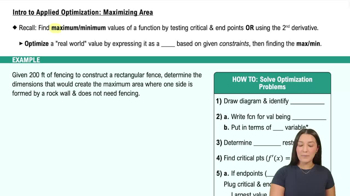
Intro to Applied Optimization: Maximizing Area
Related Practice
Textbook Question

In Exercises 9–66, graph the function using appropriate methods from the graphing procedures presented just before Example 9, identifying the coordinates of any local extreme points and inflection points. Then find coordinates of absolute extreme points, if any.

56. y = x² + 2/x

201
views
Textbook Question

A customer has asked you to design an open-top rectangular stainless steel vat. It is to have a square base and a volume of 32 ft³ , to be welded from quarter-inch plate, and to weigh no more than necessary. What dimensions do you recommend?

225
views
Textbook Question

In Exercises 9–66, graph the function using appropriate methods from the graphing procedures presented just before Example 9, identifying the coordinates of any local extreme points and inflection points. Then find coordinates of absolute extreme points, if any.

60. y = 5 / (x⁴ + 5)

111
views
Textbook Question

Your company can manufacture x hundred grade A tires and y hundred grade B tires a day, where 0 ≤ x ≤ 4 and y = (40 - 10x)/(5-x). Your profit on a grade A tire is twice your profit on a grade B tire. What is the most profitable number of each kind to make?

232
views
Textbook Question

Particle motion The positions of two particles on the s-axis are s₁ = cos t and s₂ = cos (t + π/4) .


a. What is the farthest apart the particles ever get?

238
views
Textbook Question

The sum of two nonnegative numbers is 36. Find the numbers if

a. the difference of their square roots is to be as large as possible.

b. the sum of their square roots is to be as large as possible.

171
views