Ch. 1 - Functions
Hass - Thomas' Calculus 15th Edition
Hass15th EditionThomas' CalculusISBN: 9780137616077Not the one you use?Change textbook
Chapter 1, Problem 1.3.48

Using the Half-Angle Formulas


Find the function values in Exercises 47–50.


cos² 5π/12

Verified step by step guidance
1
First, recognize that the expression cos²(θ) can be rewritten using the half-angle identity: cos²(θ) = (1 + cos(2θ))/2.
Identify the angle θ in the problem, which is 5π/12. We need to find cos²(5π/12).
Apply the half-angle formula: cos²(5π/12) = (1 + cos(2 * 5π/12))/2.
Simplify the expression inside the cosine: 2 * 5π/12 = 5π/6.
Substitute back into the formula: cos²(5π/12) = (1 + cos(5π/6))/2. Now, find the value of cos(5π/6) using the unit circle or known values.

Verified video answer for a similar problem:

This video solution was recommended by our tutors as helpful for the problem above.
Video duration:
3m
Was this helpful?

Key Concepts

Here are the essential concepts you must grasp in order to answer the question correctly.

Half-Angle Formulas

Half-angle formulas are trigonometric identities that express the sine and cosine of half an angle in terms of the sine and cosine of the original angle. For example, the cosine half-angle formula states that cos(θ/2) = ±√((1 + cos(θ))/2). These formulas are particularly useful for simplifying expressions involving angles that are not standard angles.
Recommended video:
Guided course
5:04
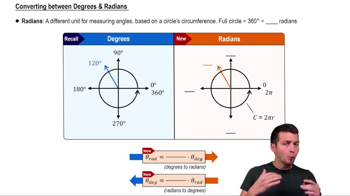
Converting between Degrees & Radians

Cosine Function

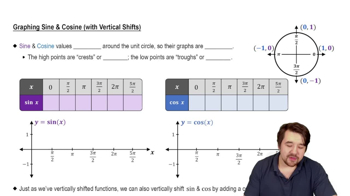
The cosine function is a fundamental trigonometric function defined as the ratio of the adjacent side to the hypotenuse in a right triangle. It is periodic with a period of 2π and is defined for all real numbers. Understanding the properties of the cosine function, including its values at key angles, is essential for solving trigonometric problems.
Recommended video:
5:53
Graph of Sine and Cosine Function

Angle Conversion

Angle conversion involves changing the measure of an angle from one unit to another, such as from degrees to radians. In this context, 5π/12 radians can be converted to degrees for better understanding or verification. Knowing how to convert angles is crucial when applying trigonometric identities and formulas, especially when dealing with non-standard angles.
Recommended video:
8:22
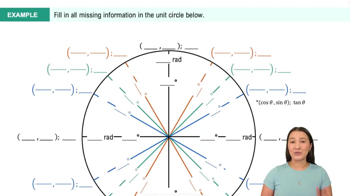
Trig Values in Quadrants II, III, & IV Example 2