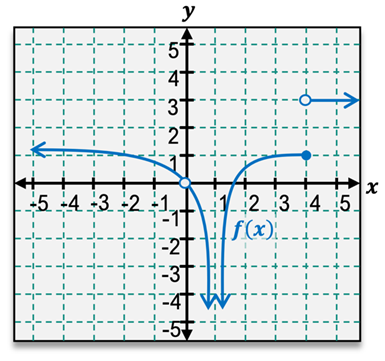
Find the limit using the graph of shown.
Table of contents
- 0. Functions7h 55m
- Introduction to Functions18m
- Piecewise Functions10m
- Properties of Functions9m
- Common Functions1h 8m
- Transformations5m
- Combining Functions27m
- Exponent rules32m
- Exponential Functions28m
- Logarithmic Functions24m
- Properties of Logarithms36m
- Exponential & Logarithmic Equations35m
- Introduction to Trigonometric Functions38m
- Graphs of Trigonometric Functions44m
- Trigonometric Identities47m
- Inverse Trigonometric Functions48m
- 1. Limits and Continuity2h 2m
- 2. Intro to Derivatives1h 33m
- 3. Techniques of Differentiation3h 18m
- 4. Applications of Derivatives2h 38m
- 5. Graphical Applications of Derivatives6h 2m
- 6. Derivatives of Inverse, Exponential, & Logarithmic Functions2h 37m
- 7. Antiderivatives & Indefinite Integrals1h 26m
- 8. Definite Integrals4h 44m
- 9. Graphical Applications of Integrals2h 27m
- 10. Physics Applications of Integrals 3h 16m
- 11. Integrals of Inverse, Exponential, & Logarithmic Functions2h 31m
- 12. Techniques of Integration7h 41m
- 13. Intro to Differential Equations2h 55m
- 14. Sequences & Series5h 36m
- 15. Power Series2h 19m
- 16. Parametric Equations & Polar Coordinates7h 58m
1. Limits and Continuity
Introduction to Limits
Multiple Choice
Using the graph, find the specified limit or state that the limit does not exist (DNE).
limx→0−f(x) , limx→0+f(x), limx→0f(x)

A
limx→0−f(x)=0, limx→0+f(x)=0, limx→0f(x)=0
B
limx→0−f(x)=0, limx→0+f(x)=0, limx→0f(x)=DNE
C
limx→0−f(x)=−1, limx→0+f(x)=−1, limx→0f(x)=DNE
D
limx→0−f(x)=−1, limx→0+f(x)=−1, limx→0f(x)=−1
0 Comments
Verified step by step guidance1
Observe the graph of the function f(x) around x = 0. Notice that as x approaches 0 from the left (x -> 0^-), the function f(x) approaches the y-value of 0.
Similarly, as x approaches 0 from the right (x -> 0^+), the function f(x) also approaches the y-value of 0.
Since both the left-hand limit and the right-hand limit as x approaches 0 are equal to 0, the two-sided limit lim_{x->0}f(x) also exists and is equal to 0.
Therefore, we can conclude that lim_{x->0^-}f(x) = 0, lim_{x->0^+}f(x) = 0, and lim_{x->0}f(x) = 0.
The correct answer is: lim_{x->0^-}f(x) = 0, lim_{x->0^+}f(x) = 0, and lim_{x->0}f(x) = 0.
Related Videos
Related Practice
Multiple Choice
756
views
7
rank