
Ch. 2 - Limits and Continuity
Hass - Thomas' Calculus 15th Edition
Hass15th EditionThomas' CalculusISBN: 9780137616077Not the one you use?Change textbook
Chapter 2, Problem 2.6.27

Limits as x → ∞ or x → −∞


The process by which we determine limits of rational functions applies equally well to ratios containing noninteger or negative powers of x. Divide numerator and denominator by the highest power of x in the denominator and proceed from there. Find the limits in Exercises 23–36. Write ∞ or −∞ where appropriate.


lim x→∞ (2√x + x⁻¹) / (3x − 7)

Verified step by step guidance
1
Identify the highest power of x in the denominator, which is x in this case.
Divide every term in the numerator and the denominator by x, the highest power of x in the denominator.
Rewrite the expression: (2√x/x + x⁻¹/x) / (3x/x - 7/x).
Simplify each term: (2/√x + 1/x²) / (3 - 7/x).
Evaluate the limit as x approaches infinity: As x → ∞, 2/√x → 0, 1/x² → 0, and 7/x → 0, so the limit simplifies to 0/3.

Verified video answer for a similar problem:

This video solution was recommended by our tutors as helpful for the problem above.
Video duration:
2m
Was this helpful?

Key Concepts

Here are the essential concepts you must grasp in order to answer the question correctly.

Limits at Infinity

Limits at infinity refer to the behavior of a function as the input approaches positive or negative infinity. This concept is crucial for understanding how functions behave in extreme cases, particularly for rational functions where the degree of the numerator and denominator can determine the limit. Analyzing limits at infinity helps in identifying horizontal asymptotes and the end behavior of functions.
Recommended video:
03:07
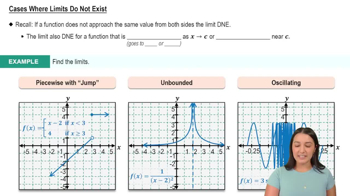
Cases Where Limits Do Not Exist

Rational Functions

Rational functions are expressions formed by the ratio of two polynomials. The degree of the polynomials in the numerator and denominator plays a significant role in determining the limit as x approaches infinity. Understanding the structure of rational functions allows for the simplification of limits by dividing through by the highest power of x, which reveals the dominant terms that dictate the limit's value.
Recommended video:
6:04
Intro to Rational Functions

Dominant Terms

In the context of limits, dominant terms are the terms in a polynomial that have the highest degree and thus have the most significant impact on the function's behavior as x approaches infinity. When evaluating limits, identifying and focusing on these terms allows for simplification of the expression, making it easier to determine the limit. This concept is essential for effectively applying the technique of dividing by the highest power of x.
Recommended video:
2:02
Simplifying Trig Expressions Example 1