Ch. 1 - Functions
Hass - Thomas' Calculus 15th Edition
Hass15th EditionThomas' CalculusISBN: 9780137616077Not the one you use?Change textbook
Chapter 1, Problem 1.1.56

Even and Odd Functions


In Exercises 47–62, say whether the function is even, odd, or neither. Give reasons for your answer.


h(t) = |t³|

Verified step by step guidance
1
To determine if a function is even, odd, or neither, we need to analyze the function's symmetry properties. A function f(t) is even if f(-t) = f(t) for all t in the domain, and it is odd if f(-t) = -f(t) for all t in the domain.
Consider the given function h(t) = |t³|. First, let's find h(-t) by substituting -t into the function: h(-t) = |-t³|.
Since the cube of a negative number is negative, we have (-t)³ = -(t³). Therefore, |-t³| = |-1 * t³| = |t³|, because the absolute value negates the negative sign.
Now, compare h(-t) with h(t): h(-t) = |t³| and h(t) = |t³|. Since h(-t) = h(t), the function h(t) is even.
Thus, the function h(t) = |t³| is an even function because it satisfies the condition h(-t) = h(t) for all t in its domain.

Verified video answer for a similar problem:

This video solution was recommended by our tutors as helpful for the problem above.
Video duration:
2m
Was this helpful?

Key Concepts

Here are the essential concepts you must grasp in order to answer the question correctly.

Even Functions

A function is classified as even if it satisfies the condition f(-x) = f(x) for all x in its domain. This means that the graph of the function is symmetric with respect to the y-axis. For example, the function f(x) = x² is even because f(-x) = (-x)² = x².
Recommended video:
6:13
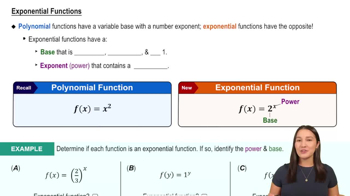
Exponential Functions

Odd Functions

A function is considered odd if it meets the condition f(-x) = -f(x) for all x in its domain. This indicates that the graph of the function is symmetric with respect to the origin. An example of an odd function is f(x) = x³, as f(-x) = (-x)³ = -x³.
Recommended video:
06:21
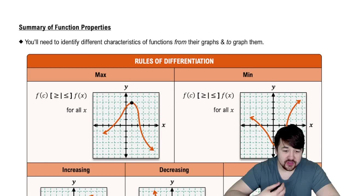
Properties of Functions

Absolute Value Function

The absolute value function, denoted as |x|, outputs the non-negative value of x regardless of its sign. This function is neither even nor odd because it does not satisfy the conditions for either classification. For instance, h(t) = |t³| results in h(-t) = |-t³| = |t³|, which is equal to h(t), indicating it is even, but the cubic term's sign negation complicates its classification.
Recommended video:
06:37
Average Value of a Function