


Ch. 4 - Applications of the Derivative
Briggs - Calculus: Early Transcendentals 3rd Edition
Briggs3rd EditionCalculus: Early TranscendentalsISBN: 9780136847243Not the one you use?Change textbook
Chapter 4, Problem 4.4.11

Sketch a continuous function f on some interval that has the properties described. Answers will vary.


The function f satisfies f'(-2) = 2, f'(0) = 0, f'(1) = -3 and f'(4) = 1.

Verified step by step guidance
1
Understand that f'(x) represents the derivative of the function f(x), which gives the slope of the tangent line to the curve at any point x. The given values of f'(x) indicate the slope of the function at specific points.
At x = -2, f'(-2) = 2, which means the slope of the tangent line to the function at x = -2 is 2. This suggests that the function is increasing at this point.
At x = 0, f'(0) = 0, indicating that the slope of the tangent line is zero. This typically means there is a horizontal tangent line at this point, suggesting a local maximum or minimum.
At x = 1, f'(1) = -3, which means the slope of the tangent line is -3. This indicates that the function is decreasing at this point.
At x = 4, f'(4) = 1, indicating that the slope of the tangent line is 1. This suggests that the function is increasing at this point. Use these slopes to sketch a function that transitions smoothly through these points, ensuring continuity.

Verified video answer for a similar problem:

This video solution was recommended by our tutors as helpful for the problem above.
Video duration:
3m
Was this helpful?

Key Concepts

Here are the essential concepts you must grasp in order to answer the question correctly.

Derivative

The derivative of a function at a point measures the rate at which the function's value changes as its input changes. It is represented as f'(x) and provides information about the function's slope at that specific point. Understanding the values of the derivative at given points helps in determining the function's behavior, such as increasing or decreasing intervals.
Recommended video:
05:44
Derivatives

Critical Points

Critical points occur where the derivative of a function is zero or undefined. These points are significant because they can indicate local maxima, minima, or points of inflection. In the context of the given question, f'(0) = 0 suggests a critical point, which is essential for sketching the function and understanding its overall shape.
Recommended video:
04:50
Critical Points

Continuity

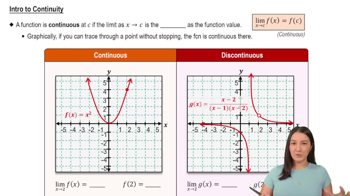
A function is continuous on an interval if there are no breaks, jumps, or holes in its graph. This property ensures that the function can be drawn without lifting the pencil from the paper. For the function f in the question, being continuous means that it must smoothly connect the points defined by the derivative values, influencing how the function is sketched across the specified interval.
Recommended video:
05:34
Intro to Continuity
Related Practice