Ch. 1 - Functions
Briggs - Calculus: Early Transcendentals 3rd Edition
Briggs3rd EditionCalculus: Early TranscendentalsISBN: 9780136847243Not the one you use?Change textbook
Chapter 1, Problem 21

Demand function Sales records indicate that if Blu-ray players are priced at \$250, then a large store sells an average of 12 units per day. If they are priced at \$200, then the store sells an average of 15 units per day. Find and graph the linear demand function for Blu-ray sales. For what prices is the demand function defined?

Verified step by step guidance
1
Step 1: Identify the given points that represent price and quantity pairs. The points are (250, 12) and (200, 15), where the first number in each pair is the price and the second is the quantity sold.
Step 2: Use the two points to find the slope of the demand function. The slope \( m \) is calculated using the formula \( m = \frac{y_2 - y_1}{x_2 - x_1} \), where \((x_1, y_1) = (250, 12)\) and \((x_2, y_2) = (200, 15)\).
Step 3: With the slope \( m \) found, use the point-slope form of a linear equation \( y - y_1 = m(x - x_1) \) to write the equation of the line. You can use either of the given points for \((x_1, y_1)\).
Step 4: Simplify the equation from the point-slope form to the slope-intercept form \( y = mx + b \), where \( b \) is the y-intercept. This gives you the linear demand function.
Step 5: Determine the domain of the demand function. The domain is the set of all possible prices for which the demand function is defined. Consider the context of the problem to decide reasonable price limits.

Verified video answer for a similar problem:

This video solution was recommended by our tutors as helpful for the problem above.
Video duration:
9m
Was this helpful?

Key Concepts

Here are the essential concepts you must grasp in order to answer the question correctly.

Linear Demand Function

A linear demand function represents the relationship between the price of a product and the quantity demanded, typically expressed in the form Q = mP + b, where Q is quantity, P is price, m is the slope, and b is the y-intercept. In this context, the slope indicates how much the quantity demanded changes with a change in price, allowing for predictions about sales at different price points.
Recommended video:
07:17
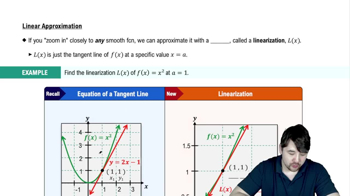
Linearization

Slope Calculation

The slope of a linear function is calculated as the change in quantity divided by the change in price (ΔQ/ΔP). In this case, using the two price points provided ($250 for 12 units and $200 for 15 units), the slope can be determined, which will help in formulating the demand function. A positive slope indicates that as the price decreases, the quantity demanded increases.
Recommended video:
Guided course
3:56
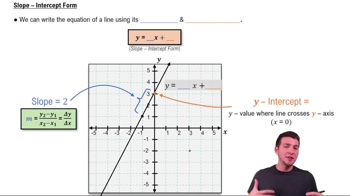
Slope-Intercept Form

Graphing the Demand Function

Graphing the demand function involves plotting the price on the vertical axis and the quantity demanded on the horizontal axis. The linear equation derived from the slope and intercept can be used to draw a straight line that represents the demand relationship. This visual representation helps in understanding how changes in price affect sales and can also indicate the range of prices over which the demand function is valid.
Recommended video:
5:53
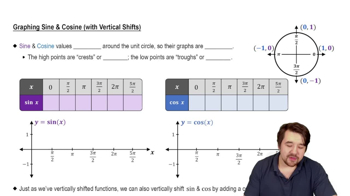
Graph of Sine and Cosine Function