
Ch. 3 - Derivatives
Hass - Thomas' Calculus 15th Edition
Hass15th EditionThomas' CalculusISBN: 9780137616077Not the one you use?Change textbook
Chapter 3, Problem 61

[Technology Exercise]


Graph y = 1/(2√x) in a window that has 0 ≤ x ≤ 2. Then, on the same screen, graph
y = (√(x + h) − √x)/h
for h = 1, 0.5, 0.1. Then try h = −1, −0.5, −0.1. Explain what is going on.

Verified step by step guidance
1
Step 1: Begin by understanding the function y = 1/(2√x). This is a transformation of the basic square root function. The graph of y = √x is a curve that starts at the origin (0,0) and increases slowly. The function y = 1/(2√x) is a reciprocal function, which means it will have a vertical asymptote at x = 0 and will decrease as x increases.
Step 2: Set up your graphing window to display the range 0 ≤ x ≤ 2. This will allow you to see the behavior of the function y = 1/(2√x) within this interval. The graph will start from a high value at x = 0 and decrease as x approaches 2.
Step 3: Next, graph the function y = (√(x + h) − √x)/h for different values of h. Start with h = 1. This function represents the difference quotient, which is used to approximate the derivative of √x. As h approaches 0, this function approximates the slope of the tangent line to the curve y = √x at a given point.
Step 4: Repeat the graphing for h = 0.5 and h = 0.1. As h gets smaller, the graph of y = (√(x + h) − √x)/h should get closer to the derivative of y = √x, which is 1/(2√x). This is because the difference quotient becomes a better approximation of the derivative as h approaches 0.
Step 5: Now, try negative values for h: h = -1, -0.5, -0.1. When h is negative, the function y = (√(x + h) − √x)/h represents the slope of the secant line from x to x + h, where x + h is less than x. This will give you a negative slope, and as h approaches 0 from the negative side, the graph should again approach the derivative of y = √x, which is 1/(2√x). This demonstrates the concept of the derivative from both the left and right sides.

Verified video answer for a similar problem:

This video solution was recommended by our tutors as helpful for the problem above.
Video duration:
8m
Was this helpful?

Key Concepts

Here are the essential concepts you must grasp in order to answer the question correctly.

Graphing Functions

Graphing functions involves plotting points on a coordinate plane to visualize the behavior of mathematical expressions. For y = 1/(2√x), understanding how the function behaves as x approaches 0 and 2 is crucial. This function is a transformation of the basic square root function, scaled and inverted, which affects its shape and position on the graph.
Recommended video:
5:53
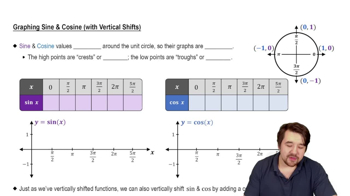
Graph of Sine and Cosine Function

Limits and Continuity

Limits help us understand the behavior of functions as they approach specific points or infinity. The expression y = (√(x + h) − √x)/h is a difference quotient, which is used to approximate the derivative of √x. As h approaches zero, this quotient gives insight into the instantaneous rate of change, highlighting the concept of limits and continuity in calculus.
Recommended video:
05:34
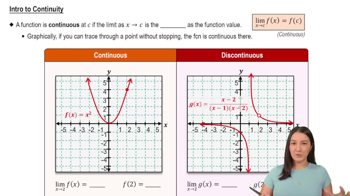
Intro to Continuity

Derivative Approximation

The derivative of a function represents its rate of change. The expression y = (√(x + h) − √x)/h approximates the derivative of √x using finite differences. By varying h, we observe how the approximation improves as h approaches zero, demonstrating the fundamental idea of derivatives as limits of difference quotients, essential for understanding calculus.
Recommended video:
05:44
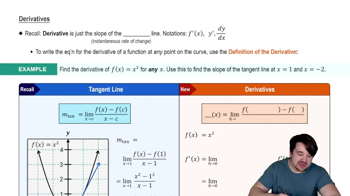
Derivatives
Related Practice
Textbook Question

Temperature and the period of a pendulum For oscillations of small amplitude (short swings), we may safely model the relationship between the period T and the length L of a simple pendulum with the equation:


T = 2π√(L/g),


where g is the constant acceleration of gravity at the pendulum’s location. If we measure g in centimeters per second squared, we measure L in centimeters and T in seconds. If the pendulum is made of metal, its length will vary with temperature, either increasing or decreasing at a rate that is roughly proportional to L. In symbols, with u being temperature and k the proportionality constant,


dL/du = kL.


Assuming this to be the case, show that the rate at which the period changes with respect to temperature is kT/2.

268
views
Textbook Question

Find the value of dy/dt at t = 0 if y = 3 sin 2x and x = t² + π.

310
views
Textbook Question

Assume that a particle’s position on the x-axis is given by


x = 3 cos t + 4 sin t,


where x is measured in feet and t is measured in seconds.


a. Find the particle’s position when t = 0, t = π/2, and t = π.

185
views
Textbook Question

If x¹/³ + y¹/³ = 4, find d²y/dx² at the point (8, 8).

256
views
Textbook Question

Assume that a particle’s position on the x-axis is given by


x = 3 cos t + 4 sin t,


where x is measured in feet and t is measured in seconds.


b. Find the particle’s velocity when t = 0, t = π/2, and t = π.

228
views
Textbook Question

Derivative of y = |x| Graph the derivative of f(x) = |x|. Then graph y = (|x| − 0)/(x − 0) = |x|/x. What can you conclude?

243
views