Determine the following limits. lim θ→∞ cos θ / θ2
Verified step by step guidance
1
Identify the type of limit: This is a limit as \( \theta \to \infty \).
Recognize that \( \cos \theta \) is bounded: \( -1 \leq \cos \theta \leq 1 \).
Note that \( \theta^2 \) grows without bound as \( \theta \to \infty \).
Apply the Squeeze Theorem: Since \( -1/\theta^2 \leq \cos \theta / \theta^2 \leq 1/\theta^2 \) and both \( -1/\theta^2 \) and \( 1/\theta^2 \) approach 0 as \( \theta \to \infty \), the limit of \( \cos \theta / \theta^2 \) is 0.
This video solution was recommended by our tutors as helpful for the problem above
Video duration:
4m
Play a video:
0 Comments
Key Concepts
Here are the essential concepts you must grasp in order to answer the question correctly.
Limits
Limits are fundamental concepts in calculus that describe the behavior of a function as its input approaches a certain value. In this case, we are interested in the limit of the function cos(θ) / θ² as θ approaches infinity. Understanding limits helps in analyzing the behavior of functions at points where they may not be explicitly defined.
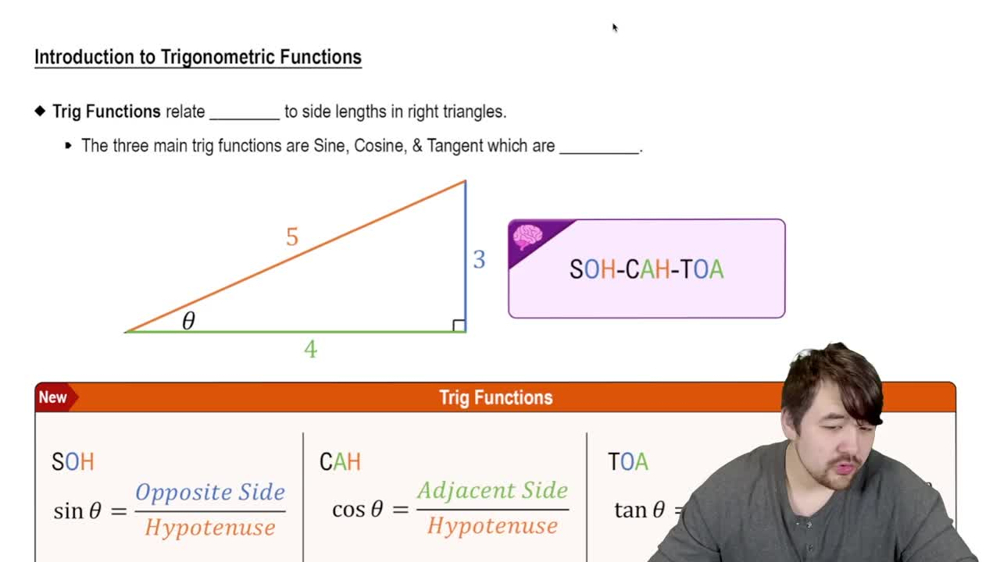
Trigonometric functions, such as cosine, are periodic functions that relate angles to ratios of sides in right triangles. The function cos(θ) oscillates between -1 and 1 for all values of θ. This periodic nature is crucial when evaluating limits involving trigonometric functions, especially as the input approaches infinity.
In calculus, when evaluating limits involving rational functions, it is important to consider the growth rates of the numerator and denominator. In the limit lim θ→∞ cos(θ) / θ², the denominator θ² grows much faster than the bounded numerator cos(θ). This concept helps determine that the limit approaches zero as θ approaches infinity.

 4:41 minutes
 Verified step by step guidance
 05:50
05:50