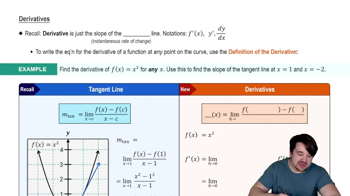
Step 1: Recall the definition of the derivative using limits. The derivative of a function f(x) at a point x is given by the limit: f'(x) = \(\lim\)_{h \(\to\) 0} \(\frac{f(x+h) - f(x)}{h}\).
Step 2: Substitute the given function f(x) = 7x into the derivative definition. This gives us: f'(x) = \(\lim\)_{h \(\to\) 0} \(\frac{7(x+h) - 7x}{h}\).
Step 3: Simplify the expression inside the limit. Distribute the 7 in the numerator: 7(x+h) = 7x + 7h. So, the expression becomes: \(\frac{7x + 7h - 7x}{h}\).
Step 4: Cancel out the terms in the numerator. The 7x terms cancel each other, leaving: \(\frac{7h}{h}\).
Step 5: Simplify the fraction by canceling h in the numerator and denominator, resulting in 7. Therefore, f'(x) = \(\lim\)_{h \(\to\) 0} 7 = 7.
Verified video answer for a similar problem:
This video solution was recommended by our tutors as helpful for the problem above
Video duration:
1m
Play a video:
0 Comments
Key Concepts
Here are the essential concepts you must grasp in order to answer the question correctly.
Limits
Limits are fundamental in calculus, representing the value that a function approaches as the input approaches a certain point. They are essential for defining derivatives, as they allow us to analyze the behavior of functions at specific points, particularly when dealing with continuity and instantaneous rates of change.
A derivative represents the rate of change of a function with respect to its variable. It is defined as the limit of the average rate of change of the function as the interval approaches zero. In this context, finding f'(x) involves applying the limit definition of the derivative to the function f(x) = 7x.
Function notation, such as f(x), is a way to express mathematical relationships where 'f' denotes a function and 'x' is the input variable. Understanding function notation is crucial for interpreting and manipulating functions, especially when calculating derivatives or evaluating limits, as it provides clarity on how inputs relate to outputs.