Ch. 1 - Functions
Hass - Thomas' Calculus 15th Edition
Hass15th EditionThomas' CalculusISBN: 9780137616077Not the one you use?Change textbook
Chapter 1, Problem 1.1.18

Functions and Graphs


Find the natural domain and graph the functions in Exercises 15–20.


g(x) = √−x

Verified step by step guidance
1
Identify the expression inside the square root: In the function \( g(x) = \sqrt{-x} \), the expression inside the square root is \(-x\).
Determine the domain of the square root function: The square root function is defined for non-negative values. Therefore, \(-x \geq 0\).
Solve the inequality for \(x\): From \(-x \geq 0\), we can multiply both sides by \(-1\) (remembering to reverse the inequality sign) to get \(x \leq 0\).
Conclude the natural domain: The natural domain of \(g(x)\) is all real numbers \(x\) such that \(x \leq 0\). In interval notation, this is \((-\infty, 0]\).
Graph the function: Since \(g(x) = \sqrt{-x}\) is defined for \(x \leq 0\), plot the graph starting from \(x = 0\) and extending to the left. The graph will be a reflection of the square root function \(\sqrt{x}\) across the y-axis, starting at the point \((0, 0)\) and moving leftward.

Verified video answer for a similar problem:

This video solution was recommended by our tutors as helpful for the problem above.
Video duration:
7m
Was this helpful?

Key Concepts

Here are the essential concepts you must grasp in order to answer the question correctly.

Natural Domain

The natural domain of a function is the set of all possible input values (x-values) for which the function is defined. For the function g(x) = √−x, the expression under the square root must be non-negative, which means −x ≥ 0 or x ≤ 0. Thus, the natural domain of g(x) is all real numbers less than or equal to zero.
Recommended video:
5:10
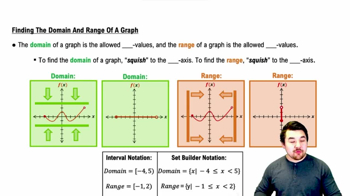
Finding the Domain and Range of a Graph

Square Root Function

A square root function, such as g(x) = √−x, is defined as the principal square root of a number, which is the non-negative value that, when squared, gives the original number. In this case, since we are taking the square root of a negative input (−x), it is crucial to understand that the function is only defined for non-positive values of x, leading to real outputs.
Recommended video:
7:24
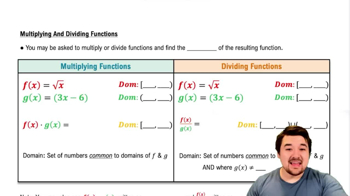
Multiplying & Dividing Functions

Graphing Functions

Graphing a function involves plotting its output values against its input values on a coordinate plane. For g(x) = √−x, the graph will only include points where x is less than or equal to zero. The resulting graph will be a curve that starts at the origin (0,0) and extends leftward, reflecting the values of the function as x decreases.
Recommended video:
5:53
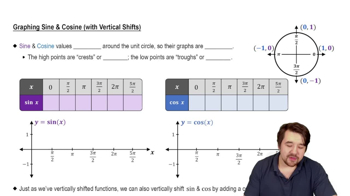
Graph of Sine and Cosine Function