The position of an object moving vertically along a line is given by the function . Find the average velocity of the object over the following intervals.
Ch. 2 - Limits
Briggs3rd EditionCalculus: Early TranscendentalsISBN: 9780136847243Not the one you use?Change textbook
Chapter 2, Problem 14
Determine the following limits.
lim x→a (3x + 1)^2 − (3a + 1)^2 / x − a, where a is constant
Verified step by step guidance1
Recognize that the given limit is in the indeterminate form 0/0 when x approaches a, which suggests using algebraic manipulation or L'Hôpital's Rule.
Notice that the expression (3x + 1)^2 − (3a + 1)^2 is a difference of squares, which can be factored as [(3x + 1) - (3a + 1)][(3x + 1) + (3a + 1)].
Simplify the difference of squares: [(3x + 1) - (3a + 1)] becomes 3(x - a) and [(3x + 1) + (3a + 1)] becomes 6x + 6a + 2.
Substitute the factored form into the limit expression: lim x→a [3(x - a)(6x + 6a + 2)] / (x - a).
Cancel the (x - a) terms in the numerator and denominator, then evaluate the limit of the remaining expression as x approaches a.

Verified video answer for a similar problem:
This video solution was recommended by our tutors as helpful for the problem above.
Video duration:
4mWas this helpful?
Key Concepts
Here are the essential concepts you must grasp in order to answer the question correctly.
Limits
A limit is a fundamental concept in calculus that describes the behavior of a function as its input approaches a certain value. In this case, we are interested in the limit of the expression as x approaches a. Understanding limits is crucial for analyzing continuity, derivatives, and integrals, as they form the foundation for these concepts.
Recommended video:
One-Sided Limits
Difference of Squares
The difference of squares is an algebraic identity that states a^2 - b^2 = (a - b)(a + b). This identity can simplify expressions involving squares, making it easier to evaluate limits. In the given limit problem, recognizing that the expression can be factored using this identity will help in simplifying the limit calculation.
Recommended video:
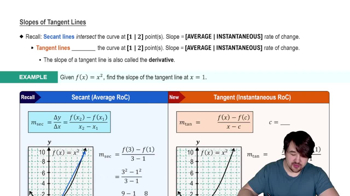
Slopes of Tangent Lines
L'Hôpital's Rule
L'Hôpital's Rule is a method for evaluating limits that result in indeterminate forms, such as 0/0 or ∞/∞. It states that if the limit of f(x)/g(x) leads to an indeterminate form, the limit can be found by taking the derivative of the numerator and the derivative of the denominator. This rule is particularly useful in the context of the given limit problem, where direct substitution leads to an indeterminate form.
Recommended video:
Guided course
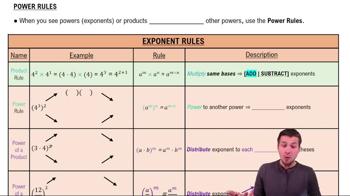
Power Rules
Related Practice
Textbook Question
359
views
Textbook Question
The position of an object moving vertically along a line is given by the function . Find the average velocity of the object over the following intervals.
378
views
Textbook Question
Determine the following limits.
lim h→0 (h + 6)^2 + (h + 6) − 42 / h
358
views
Textbook Question
Let . <IMAGE>
Make a conjecture about the values of , , and or state that they do not exist.
358
views
Textbook Question
The position of an object moving vertically along a line is given by the function . Find the average velocity of the object over the following intervals.
, where is a real number
415
views
Textbook Question
The position of an object moving vertically along a line is given by the function . Find the average velocity of the object over the following intervals.
397
views