
Textbook Question
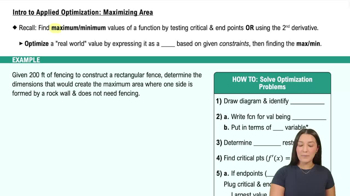
Suppose S = x + 2y is an objective function subject to the constraint xy = 50, for x > 0 and y > 0.
b. Find the absolute minimum value of S subject to the given constraint.
283
views

 Verified step by step guidance
 10:13
10:13
 05:59 10:13
Suppose S = x + 2y is an objective function subject to the constraint xy = 50, for x > 0 and y > 0.
b. Find the absolute minimum value of S subject to the given constraint.
{Use of Tech} Basketball shot A basketball is shot with an initial velocity of v ft/s at an angle of 45° to the floor. The center of the basketball is 8 ft above the floor at a horizontal distance of 18 feet from the center of the basketball hoop when it is released. The height h (in feet) of the center of the basketball after it has traveled a horizontal distance of x feet is modeled by the function h(x) = 32x² / v² + x + 8 (see figure). <IMAGE>
b. During the flight of the basketball, show that the distance s from the center of the basketball to the front of the hoop is s = √ (x - 17.25)² + ( -(4x² / 81) + x - 2)² (Hint: The diameter of the basketball hoop is 18 inches.)
Values of related functions Suppose f is differentiable on (-∞,∞) and assume it has a local extreme value at the point x = 2, where f(2) = 0. Let g(x) = xf(x) + 1 and let h(x) = xf(x) + x +1, for all values of x.
b. Does either g or h have a local extreme value at x = 2? Explain.
{Use of Tech} A damped oscillator The displacement of an object as it bounces vertically up and down on a spring is given by y(t) = 2.5e⁻ᵗ cos 2t, where the initial displacement is y(0) = 2.5 and y = 0 corresponds to the rest position (see figure). <IMAGE>
b. Find the time and the displacement when the object reaches its lowest point.
Cylinder in a cone A right circular cylinder is placed inside a cone of radius R and height H so that the base of the cylinder lies on the base of the cone.
b. Find the dimensions of the cylinder with maximum lateral surface area (area of the curved surface).
{Use of Tech} Demand functions and elasticity Economists use demand functions to describe how much of a commodity can be sold at varying prices. For example, the demand function D(p) = 500 - 10p says that at a price of p = 10, a quantity of D(10) = 400 units of the commodity can be sold. The elasticity E = dD/dp p/D of the demand gives the approximate percent change in the demand for every 1% change in the price. (See Section 3.6 or the Guided Project Elasticity in Economics for more on demand functions and elasticity.)
b. If the price is \$12 and increases by 4.5%, what is the approximate percent change in the demand?