Ch. 1 - Functions
Briggs - Calculus: Early Transcendentals 3rd Edition
Briggs3rd EditionCalculus: Early TranscendentalsISBN: 9780136847243Not the one you use?Change textbook
Chapter 1, Problem 1.1.70

Simplify the difference quotient (ƒ(x)-ƒ(a)) / (x-a) for the following functions.
ƒ(x) = 4 - 4x + x²

Verified step by step guidance
1
Step 1: Start by substituting the function \( f(x) = 4 - 4x + x^2 \) into the difference quotient formula \( \frac{f(x) - f(a)}{x-a} \).
Step 2: Calculate \( f(a) \) by substituting \( a \) into the function: \( f(a) = 4 - 4a + a^2 \).
Step 3: Substitute \( f(x) \) and \( f(a) \) into the difference quotient: \( \frac{(4 - 4x + x^2) - (4 - 4a + a^2)}{x-a} \).
Step 4: Simplify the numerator by distributing and combining like terms: \( (4 - 4x + x^2) - (4 - 4a + a^2) = -4x + x^2 + 4a - a^2 \).
Step 5: Factor the simplified expression in the numerator, if possible, and then divide by \( x-a \) to simplify the difference quotient further.

Verified video answer for a similar problem:

This video solution was recommended by our tutors as helpful for the problem above.
Video duration:
3m
Was this helpful?

Key Concepts

Here are the essential concepts you must grasp in order to answer the question correctly.

Difference Quotient

The difference quotient is a formula used to calculate the average rate of change of a function over an interval. It is expressed as (ƒ(x) - ƒ(a)) / (x - a), where ƒ(x) is the function value at x and ƒ(a) is the function value at a. This concept is foundational in calculus as it leads to the definition of the derivative, which represents the instantaneous rate of change.
Recommended video:
06:43
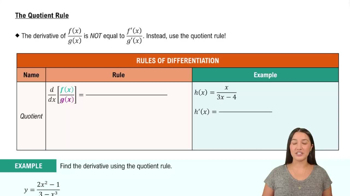
The Quotient Rule

Function Simplification

Function simplification involves rewriting a mathematical expression in a more manageable or understandable form. In the context of the given function ƒ(x) = 4 - 4x + x², simplification may include combining like terms, factoring, or expanding expressions. This process is crucial for effectively applying calculus concepts such as differentiation or integration.
Recommended video:
06:21
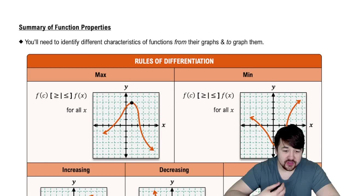
Properties of Functions

Calculus and Derivatives

Calculus is a branch of mathematics that studies continuous change, and derivatives are a key concept within it. The derivative of a function at a point provides the slope of the tangent line to the function at that point, representing the instantaneous rate of change. Understanding how to compute derivatives from the difference quotient is essential for analyzing the behavior of functions.
Recommended video:
06:11
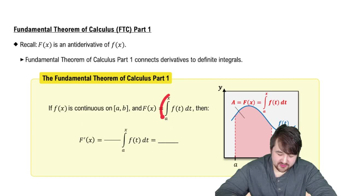
Fundamental Theorem of Calculus Part 1