In Exercises 19β32, find the (a) domain and (b) range.
π = 2eβ»Λ£ - 3
Verified step by step guidance
1
Step 1: Understand the function given, which is π = 2eβ»Λ£ - 3. This is an exponential function where the base is e (Euler's number) and the exponent is -x.
Step 2: Determine the domain of the function. The domain of an exponential function is all real numbers because you can substitute any real number for x without restriction. Therefore, the domain is (-β, β).
Step 3: Analyze the behavior of the function to find the range. As x approaches positive infinity, eβ»Λ£ approaches 0, making π approach -3. As x approaches negative infinity, eβ»Λ£ becomes very large, making π approach positive infinity.
Step 4: Conclude the range based on the behavior of the function. Since π approaches -3 but never actually reaches it, and can increase without bound, the range is (-3, β).
Step 5: Summarize the findings: The domain of the function is all real numbers (-β, β), and the range is all real numbers greater than -3, which is (-3, β).
Verified video answer for a similar problem:

This video solution was recommended by our tutors as helpful for the problem above
Video duration:
3m
Play a video:
0 Comments
Key Concepts
Here are the essential concepts you must grasp in order to answer the question correctly.
Domain of a Function
The domain of a function refers to the set of all possible input values (x-values) for which the function is defined. For the function y = 2eβ»Λ£ - 3, the exponential function eβ»Λ£ is defined for all real numbers, meaning the domain is all real numbers, or (-β, β). Understanding the domain is crucial for determining where the function can be evaluated.
The range of a function is the set of all possible output values (y-values) that the function can produce. For the function y = 2eβ»Λ£ - 3, as x approaches infinity, eβ»Λ£ approaches 0, making y approach -3. As x approaches negative infinity, y approaches positive infinity. Thus, the range is (-3, β). Knowing the range helps in understanding the behavior of the function.
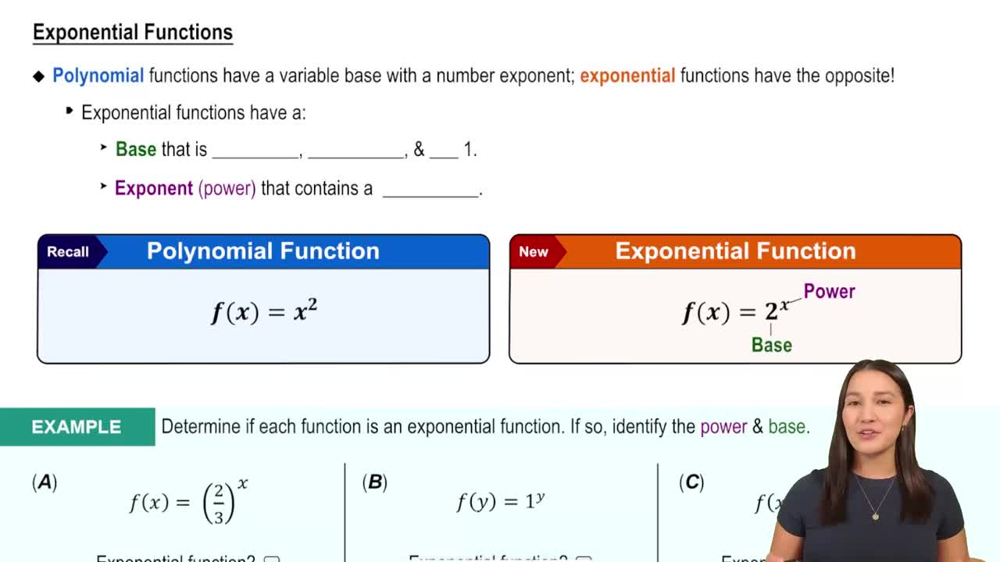
Exponential functions are mathematical functions of the form f(x) = a * bΛ£, where a is a constant, b is a positive real number, and x is the exponent. In the given function y = 2eβ»Λ£ - 3, the base e (approximately 2.718) is a natural constant, and the function exhibits rapid growth or decay. Understanding the properties of exponential functions is essential for analyzing their behavior and transformations.