Ch. 2 - Limits
Briggs - Calculus: Early Transcendentals 3rd Edition
Briggs3rd EditionCalculus: Early TranscendentalsISBN: 9780136847243Not the one you use?Change textbook
Chapter 2, Problem 75a

Evaluate lim x→2^+ √x−2.

Verified step by step guidance
1
Identify the type of limit: This is a one-sided limit as x approaches 2 from the right (x→2^+).
Understand the behavior of the function: As x approaches 2 from the right, x is slightly greater than 2, so x - 2 is a small positive number.
Consider the expression under the square root: Since x is approaching 2 from the right, the expression \( \sqrt{x - 2} \) involves taking the square root of a small positive number.
Analyze the limit: As x gets closer to 2 from the right, the value of \( x - 2 \) approaches 0, making \( \sqrt{x - 2} \) approach the square root of 0.
Conclude the behavior of the limit: The limit of \( \sqrt{x - 2} \) as x approaches 2 from the right is the square root of 0.

Verified video answer for a similar problem:

This video solution was recommended by our tutors as helpful for the problem above.
Video duration:
3m
Was this helpful?

Key Concepts

Here are the essential concepts you must grasp in order to answer the question correctly.

Limits

A limit is a fundamental concept in calculus that describes the behavior of a function as its input approaches a certain value. In this case, we are interested in the limit as x approaches 2 from the right (denoted as 2^+). Understanding limits is crucial for analyzing the continuity and behavior of functions at specific points.
Recommended video:
05:50
One-Sided Limits

One-Sided Limits

One-sided limits refer to the value that a function approaches as the input approaches a specific point from one side only. The notation lim x→2^+ indicates that we are considering values of x that are greater than 2. This concept is important for understanding how functions behave near points of discontinuity or where they may not be defined.
Recommended video:
05:50
One-Sided Limits

Square Root Function

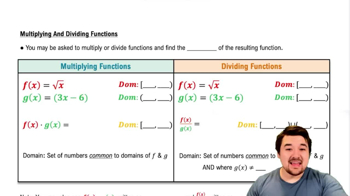
The square root function, denoted as √x, is a function that returns the non-negative value whose square is x. In the context of the limit, we are evaluating √x - 2 as x approaches 2. Understanding the properties of the square root function, including its domain and behavior near specific points, is essential for accurately calculating the limit.
Recommended video:
7:24
Multiplying & Dividing Functions