Ch. 1 - Functions
Briggs - Calculus: Early Transcendentals 3rd Edition
Briggs3rd EditionCalculus: Early TranscendentalsISBN: 9780136847243Not the one you use?Change textbook
Chapter 1, Problem 1.3.25

Use analytical and/or graphical methods to determine the largest possible sets of points on which the following functions have an inverse.
{Use of Tech} f(x)=1x2f\(\left\)(x\(\right\))=\(\frac{1}{x^2}\)

Verified step by step guidance
1
Step 1: Understand that for a function to have an inverse, it must be one-to-one (bijective). A function is one-to-one if it passes the horizontal line test, meaning no horizontal line intersects the graph of the function more than once.
Step 2: Consider the function f(x) = \(\frac{1}{x^2}\). Analyze its behavior: as x approaches 0 from either side, f(x) approaches infinity, and as x approaches positive or negative infinity, f(x) approaches 0.
Step 3: Note that f(x) = \(\frac{1}{x^2}\) is not one-to-one over its entire domain because for any positive y, there are two x-values (one positive and one negative) that map to y. This violates the horizontal line test.
Step 4: To find the largest possible set where f(x) has an inverse, restrict the domain to either x > 0 or x < 0. This restriction ensures that the function is one-to-one, as each y-value corresponds to exactly one x-value.
Step 5: Conclude that the largest possible sets of points on which f(x) = \(\frac{1}{x^2}\) has an inverse are the intervals (0, ∞) or (-∞, 0). On these intervals, the function is strictly decreasing or increasing, respectively, and thus one-to-one.

Verified video answer for a similar problem:

This video solution was recommended by our tutors as helpful for the problem above.
Video duration:
2m
Was this helpful?

Key Concepts

Here are the essential concepts you must grasp in order to answer the question correctly.

Inverse Functions

An inverse function essentially reverses the effect of the original function. For a function f(x), its inverse f⁻¹(y) satisfies the condition f(f⁻¹(y)) = y for all y in the range of f. A function has an inverse if it is one-to-one, meaning that it passes the horizontal line test, where no horizontal line intersects the graph of the function more than once.
Recommended video:
4:49
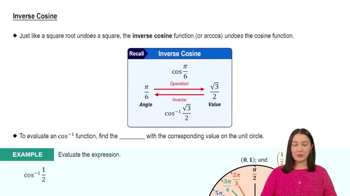
Inverse Cosine

Horizontal Line Test

The horizontal line test is a method used to determine if a function is one-to-one. If any horizontal line drawn across the graph of the function intersects it at more than one point, the function fails the test and does not have an inverse. This test is crucial for identifying the largest sets of points where a function can be inverted.
Recommended video:
5:28
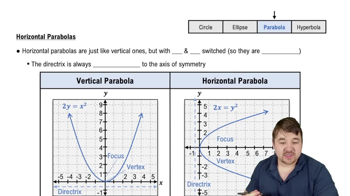
Horizontal Parabolas

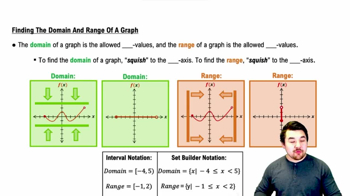
Domain and Range

The domain of a function is the set of all possible input values (x-values), while the range is the set of all possible output values (y-values). Understanding the domain and range is essential for determining where a function is one-to-one and thus can have an inverse. For the function f(x) = 1/x², the domain excludes zero, and the range consists of positive values, which influences its invertibility.
Recommended video:
5:10
Finding the Domain and Range of a Graph