a. Estimate lim x→π/4 cos 2x / cos x − sin x by making a table of values of cos 2x / cos x − sin x for values of x approaching π/4. Round your estimate to four digits.
Ch. 2 - Limits
Briggs3rd EditionCalculus: Early TranscendentalsISBN: 9780136847243Not the one you use?Change textbook
Chapter 2, Problem 2.4.30a
Determine the following limits.
a.
Verified step by step guidance1
Identify the limit expression: \( \lim_{x \to 1^{+}} \frac{x-3}{\sqrt{x^2-5x+4}} \).
Factor the expression under the square root: \( x^2 - 5x + 4 = (x-1)(x-4) \).
Substitute \( x = 1^{+} \) into the factored expression: \( \sqrt{(x-1)(x-4)} \) becomes \( \sqrt{(1^{+}-1)(1^{+}-4)} \).
Analyze the behavior of the numerator and denominator as \( x \to 1^{+} \): The numerator \( x-3 \) approaches \( 1-3 = -2 \), and the denominator approaches \( \sqrt{0 \cdot (-3)} = 0 \).
Conclude that the limit involves division by zero, indicating a potential vertical asymptote or undefined behavior, and further analysis is needed to determine the limit's behavior.

Verified video answer for a similar problem:
This video solution was recommended by our tutors as helpful for the problem above.
Video duration:
4mWas this helpful?
Key Concepts
Here are the essential concepts you must grasp in order to answer the question correctly.
Limits
Limits are fundamental concepts in calculus that describe the behavior of a function as its input approaches a certain value. They help in understanding how functions behave near points of interest, including points where they may not be defined. In this question, we are specifically looking at the limit as x approaches 1 from the right, which is denoted as x → 1⁺.
Recommended video:
One-Sided Limits
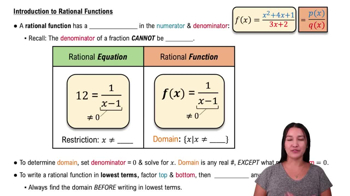
Rational Functions
A rational function is a function that can be expressed as the ratio of two polynomials. In the given limit, the numerator is a linear polynomial (x - 3) and the denominator involves a square root of a quadratic polynomial (√(x² - 5x + 4)). Understanding how to simplify and analyze rational functions is crucial for evaluating limits, especially when approaching points that may lead to indeterminate forms.
Recommended video:
Intro to Rational Functions
Indeterminate Forms
Indeterminate forms occur when the limit of a function results in an ambiguous expression, such as 0/0 or ∞/∞. In this case, as x approaches 1, both the numerator and the denominator approach specific values that may lead to an indeterminate form. Recognizing and resolving these forms, often through algebraic manipulation or L'Hôpital's rule, is essential for finding the correct limit.
Recommended video:
Guided course
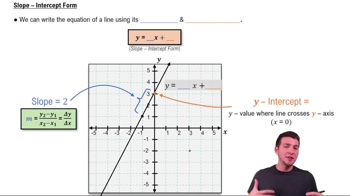
Slope-Intercept Form
Related Practice
Textbook Question
382
views
Textbook Question
Complete the following sentences in terms of a limit.
a. A function is continuous from the left at a if _____.
330
views
Textbook Question
The graph of ℎ in the figure has vertical asymptotes at x=−2 and x=3. Analyze the following limits. <IMAGE>
lim x→−2^− h(x)
397
views
Textbook Question
a. Use a graphing utility to estimate lim x→0 tan 2x / sin x, lim x→0 tan 3x / sin x, and lim x→0 tan 4x / sin x.
344
views
Textbook Question
Given the graph of f in the following figures, find the slope of the secant line that passes through (0,0) and (h,f(h))in terms of h, for h>0 and h<0.
f(x)=x1/3 <IMAGE>
362
views
Textbook Question
Graph the function f(x)=e^−x / x(x+2)^2 using a graphing utility. (Experiment with your choice of a graphing window.) Use your graph to determine the following limits.
a. lim x→−2^+ f(x)
354
views