Ch. 4 - Applications of the Derivative
Briggs - Calculus: Early Transcendentals 3rd Edition
Briggs3rd EditionCalculus: Early TranscendentalsISBN: 9780136847243Not the one you use?Change textbook
Chapter 4, Problem 4.5.38.a

Rectangles beneath a line


a. A rectangle is constructed with one side on the positive x-axis, one side on the positive y-axis, and the vertex opposite the origin on the line y = 10 - 2x. What dimensions maximize the area of the rectangle? What is the maximum area?

Verified step by step guidance
1
Identify the variables: Let the coordinates of the vertex opposite the origin be (x, y) on the line y = 10 - 2x. The dimensions of the rectangle are x (width) and y (height).
Express the area A of the rectangle as a function of x: Since y = 10 - 2x, the area A can be expressed as A(x) = x * y = x * (10 - 2x).
Simplify the area function: A(x) = 10x - 2x^2. This is a quadratic function in the form of A(x) = -2x^2 + 10x.
Find the critical points: To maximize the area, take the derivative of A(x) with respect to x, set it to zero, and solve for x. The derivative is A'(x) = 10 - 4x.
Solve for x: Set A'(x) = 0, which gives 10 - 4x = 0. Solve for x to find the critical point. Then, use the second derivative test or analyze the function to confirm that this point gives a maximum area.

Verified video answer for a similar problem:

This video solution was recommended by our tutors as helpful for the problem above.
Video duration:
3m
Was this helpful?

Key Concepts

Here are the essential concepts you must grasp in order to answer the question correctly.

Area of a Rectangle

The area of a rectangle is calculated by multiplying its length by its width. In this problem, the dimensions of the rectangle are determined by the coordinates of the vertex on the line y = 10 - 2x. Understanding how to express the area as a function of x is crucial for maximizing it.
Recommended video:
07:59
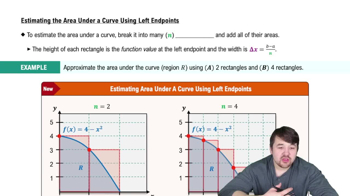
Estimating the Area Under a Curve Using Left Endpoints

Optimization

Optimization in calculus involves finding the maximum or minimum values of a function. To maximize the area of the rectangle, we need to set up the area function based on the dimensions derived from the line equation and then use techniques such as taking derivatives and finding critical points to determine the maximum area.
Recommended video:
10:13
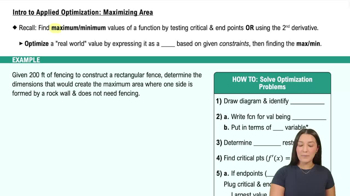
Intro to Applied Optimization: Maximizing Area

Derivatives and Critical Points

Derivatives represent the rate of change of a function and are essential for finding critical points, where the function's slope is zero or undefined. In this context, taking the derivative of the area function allows us to identify the x-value that maximizes the area, leading to the optimal dimensions of the rectangle.
Recommended video:
04:50
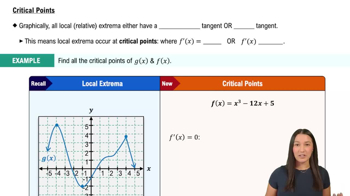
Critical Points
Related Practice
Textbook Question

Explain why or why not Determine whether the following statements are true and give an explanation or counterexample.


a. F(x) = x³ - 4x + 100 and G(x) = x³ - 4x - 100 are antiderivatives of the same function.

52
views

Textbook Question

Use the graphs of ƒ' and ƒ" to complete the following steps. <IMAGE>

a. Find the critical points of f and determine where f is increasing and where it is decreasing.

235
views
Textbook Question

Optimal popcorn box A small popcorn box is created from a 12" x 12" sheet of paperboard by first cutting out four shaded rectangles, each of length x and width x/2 (see figure). The remaining paperboard is folded along the solid lines to form a box. What dimensions of the box maximize the volume of the box? <IMAGE>

355
views
Textbook Question

{Use of Tech } Minimizing sound intensity Two sound speakers are 100 m apart and one speaker is three times as loud as the other speaker. At what point on a line segment between the speakers is the sound intensity the weakest? (Hint: Sound intensity is directly proportional to the sound level and inversely proportional to the square of the distance from the sound source.)

281
views
Textbook Question

Population models The population of a species is given by the function P(t) = Kt²/(t² + b) , where t ≥ 0 is measured in years and K and b are positive real numbers.


a. With K = 300 and b = 30, what is lim_t→∞ P(t), the carrying capacity of the population?

333
views
Textbook Question

Sketch a graph of a function f with the following properties.


f' < 0 and f" < 0, for x < -1

266
views