Ch. 4 - Applications of the Derivative
Briggs - Calculus: Early Transcendentals 3rd Edition
Briggs3rd EditionCalculus: Early TranscendentalsISBN: 9780136847243Not the one you use?Change textbook
Chapter 4, Problem 4.8.45

{Use of Tech} Newton’s method and curve sketching Use Newton’s method to find approximate answers to the following questions.
Where are the inflection points of f(x) = (9/5)x⁵ - (15/2)x⁴ + (7/3)x³ + 30x² + 1 located?

Verified step by step guidance
1
To find the inflection points of the function \( f(x) = \frac{9}{5}x^5 - \frac{15}{2}x^4 + \frac{7}{3}x^3 + 30x^2 + 1 \), we first need to find the second derivative, \( f''(x) \).
Calculate the first derivative \( f'(x) \) by differentiating \( f(x) \): \( f'(x) = \frac{d}{dx}\left(\frac{9}{5}x^5 - \frac{15}{2}x^4 + \frac{7}{3}x^3 + 30x^2 + 1\right) \).
Differentiate \( f'(x) \) to find the second derivative \( f''(x) \). This involves applying the power rule to each term of \( f'(x) \).
Set \( f''(x) = 0 \) to find potential inflection points. Solve this equation to find the critical points where the concavity might change.
Use Newton's method to approximate the roots of \( f''(x) = 0 \). Start with an initial guess \( x_0 \) and iterate using the formula \( x_{n+1} = x_n - \frac{f''(x_n)}{f'''(x_n)} \) until the values converge to a satisfactory level of precision.

Verified video answer for a similar problem:

This video solution was recommended by our tutors as helpful for the problem above.
Video duration:
11m
Was this helpful?

Key Concepts

Here are the essential concepts you must grasp in order to answer the question correctly.

Newton's Method

Newton's Method is an iterative numerical technique used to find approximate solutions to equations, particularly for finding roots of functions. It utilizes the function's derivative to refine guesses, starting from an initial estimate. The method is effective for functions that are continuous and differentiable, allowing for rapid convergence to a solution when the initial guess is close enough.
Recommended video:
4:26
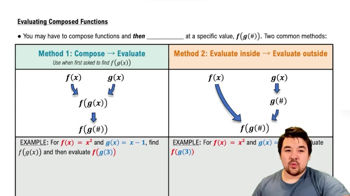
Evaluating Composed Functions

Inflection Points

Inflection points are points on a curve where the concavity changes, indicating a shift in the direction of curvature. To find inflection points, one must compute the second derivative of the function and determine where it equals zero or is undefined. These points are significant in curve sketching as they help identify changes in the behavior of the graph, such as transitions from concave up to concave down.
Recommended video:
04:50
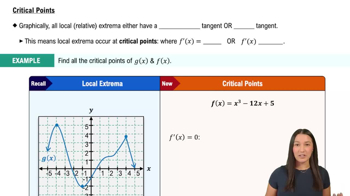
Critical Points

Second Derivative Test

The Second Derivative Test is a method used to classify critical points of a function by analyzing the sign of the second derivative. If the second derivative is positive at a critical point, the function is concave up, indicating a local minimum; if negative, it indicates a local maximum. If the second derivative is zero, the test is inconclusive, and further analysis is needed to determine the nature of the critical point.
Recommended video:
06:02
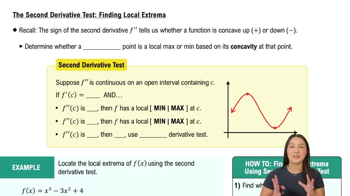
The Second Derivative Test: Finding Local Extrema