Ch. 1 - Functions
Hass - Thomas' Calculus 15th Edition
Hass15th EditionThomas' CalculusISBN: 9780137616077Not the one you use?Change textbook
Chapter 1, Problem 1.1.50

Even and Odd Functions


In Exercises 47–62, say whether the function is even, odd, or neither. Give reasons for your answer.


f(x) = x² + x

Verified step by step guidance
1
To determine if a function is even, odd, or neither, we need to analyze the function's symmetry properties. A function f(x) is even if f(-x) = f(x) for all x in the domain, and it is odd if f(-x) = -f(x) for all x in the domain.
Start by substituting -x into the function f(x) = x² + x to find f(-x). This gives us f(-x) = (-x)² + (-x).
Simplify the expression for f(-x). Since (-x)² = x², we have f(-x) = x² - x.
Compare f(-x) = x² - x with the original function f(x) = x² + x. Notice that f(-x) is not equal to f(x), so the function is not even.
Next, check if f(-x) = -f(x). Calculate -f(x) = -(x² + x) = -x² - x. Since f(-x) = x² - x is not equal to -f(x) = -x² - x, the function is not odd. Therefore, the function is neither even nor odd.

Verified video answer for a similar problem:

This video solution was recommended by our tutors as helpful for the problem above.
Video duration:
2m
Was this helpful?

Key Concepts

Here are the essential concepts you must grasp in order to answer the question correctly.

Even Functions

A function is classified as even if it satisfies the condition f(-x) = f(x) for all x in its domain. This means that the graph of the function is symmetric with respect to the y-axis. A common example of an even function is f(x) = x², where substituting -x yields the same output as substituting x.
Recommended video:
6:13
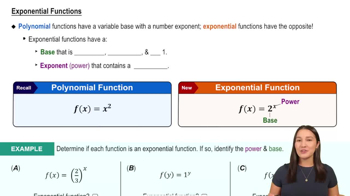
Exponential Functions

Odd Functions

A function is considered odd if it meets the condition f(-x) = -f(x) for all x in its domain. This indicates that the graph of the function is symmetric with respect to the origin. An example of an odd function is f(x) = x³, where substituting -x results in the negative of the output for x.
Recommended video:
06:21
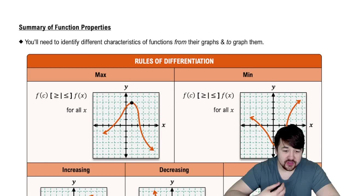
Properties of Functions

Neither Even Nor Odd Functions

A function is classified as neither even nor odd if it does not satisfy the conditions for either classification. This means that f(-x) does not equal f(x) and also does not equal -f(x). An example is f(x) = x² + x, as it does not exhibit symmetry about the y-axis or the origin.
Recommended video:
06:21
Properties of Functions