Ch. 4 - Applications of the Derivative
Briggs - Calculus: Early Transcendentals 3rd Edition
Briggs3rd EditionCalculus: Early TranscendentalsISBN: 9780136847243Not the one you use?Change textbook
Chapter 4, Problem 4.2.4

Explain the Mean Value Theorem with a sketch.

Verified step by step guidance
1
The Mean Value Theorem (MVT) is a fundamental theorem in calculus that connects the average rate of change of a function over an interval with the instantaneous rate of change at some point within that interval.
To apply the Mean Value Theorem, ensure the function \( f(x) \) is continuous on the closed interval \([a, b]\) and differentiable on the open interval \((a, b)\).
According to the MVT, there exists at least one point \( c \) in the interval \((a, b)\) such that the derivative at \( c \), \( f'(c) \), is equal to the average rate of change over \([a, b]\). Mathematically, this is expressed as: \( f'(c) = \frac{f(b) - f(a)}{b - a} \).
To visualize this, imagine the graph of \( f(x) \) over the interval \([a, b]\). The line connecting the points \((a, f(a))\) and \((b, f(b))\) is the secant line, representing the average rate of change. The MVT guarantees that there is at least one tangent line to the curve that is parallel to this secant line.
Sketch the function \( f(x) \) on a graph, draw the secant line between \((a, f(a))\) and \((b, f(b))\), and identify the point \( c \) where the tangent to the curve is parallel to the secant line, illustrating the theorem.

Verified video answer for a similar problem:

This video solution was recommended by our tutors as helpful for the problem above.
Video duration:
4m
Was this helpful?

Key Concepts

Here are the essential concepts you must grasp in order to answer the question correctly.

Mean Value Theorem (MVT)

The Mean Value Theorem states that if a function is continuous on a closed interval [a, b] and differentiable on the open interval (a, b), then there exists at least one point c in (a, b) such that the derivative at that point equals the average rate of change of the function over the interval. Mathematically, this is expressed as f'(c) = (f(b) - f(a)) / (b - a).
Recommended video:
06:11
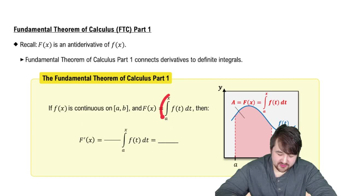
Fundamental Theorem of Calculus Part 1

Continuity and Differentiability

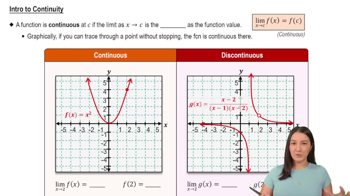
Continuity of a function at a point means that the function does not have any breaks, jumps, or holes at that point. Differentiability, on the other hand, means that the function has a defined derivative at that point. For the Mean Value Theorem to apply, the function must be both continuous on the closed interval and differentiable on the open interval.
Recommended video:
05:34
Intro to Continuity

Geometric Interpretation

Geometrically, the Mean Value Theorem can be visualized by considering the secant line that connects the endpoints of the function on the interval [a, b]. The theorem guarantees that there is at least one point c where the tangent line to the curve at that point is parallel to the secant line. This illustrates the relationship between instantaneous rate of change (the derivative) and average rate of change over an interval.
Recommended video:
03:55
The Quotient Rule Example 5