Ch. 3 - Derivatives
Briggs - Calculus: Early Transcendentals 3rd Edition
Briggs3rd EditionCalculus: Early TranscendentalsISBN: 9780136847243Not the one you use?Change textbook
Chapter 3, Problem 3.6.55c

{Use of Tech} Spring oscillations A spring hangs from the ceiling at equilibrium with a mass attached to its end. Suppose you pull downward on the mass and release it 10 inches below its equilibrium position with an upward push. The distance x (in inches) of the mass from its equilibrium position after t seconds is given by the function x(t) = 10sin t−10cos t, where x is positive when the mass is above the equilibrium position. <IMAGE>
c. At what times is the velocity of the mass zero?

Verified step by step guidance
1
To find when the velocity of the mass is zero, we first need to determine the velocity function. The velocity is the derivative of the position function x(t) with respect to time t.
Given the position function x(t) = 10sin(t) - 10cos(t), we differentiate it to find the velocity function v(t). The derivative of sin(t) is cos(t), and the derivative of cos(t) is -sin(t).
Applying these derivatives, the velocity function v(t) is: v(t) = d/dt [10sin(t) - 10cos(t)] = 10cos(t) + 10sin(t).
To find when the velocity is zero, we set the velocity function equal to zero: 10cos(t) + 10sin(t) = 0.
Solve the equation 10cos(t) + 10sin(t) = 0 for t. This involves finding the values of t where the sum of the cosine and sine terms equals zero, which can be done by using trigonometric identities or algebraic manipulation.

Verified video answer for a similar problem:

This video solution was recommended by our tutors as helpful for the problem above.
Video duration:
4m
Was this helpful?

Key Concepts

Here are the essential concepts you must grasp in order to answer the question correctly.

Velocity and Its Calculation

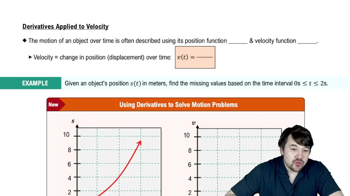
Velocity is the rate of change of position with respect to time. In calculus, it is found by taking the derivative of the position function. For the given function x(t) = 10sin(t) - 10cos(t), the velocity function v(t) can be determined by differentiating x(t) with respect to t, which will provide the times when the mass is momentarily at rest.
Recommended video:
06:29
Derivatives Applied To Velocity

Finding Critical Points

Critical points occur where the derivative of a function is zero or undefined. In the context of the velocity function, setting v(t) = 0 will help identify the times when the mass's velocity is zero, indicating moments when the mass changes direction. This is essential for understanding the oscillatory motion of the mass attached to the spring.
Recommended video:
04:50
Critical Points

Trigonometric Functions and Their Properties

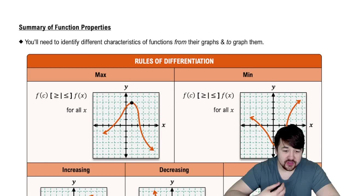
The position function x(t) involves sine and cosine functions, which are periodic and have specific properties regarding their maxima, minima, and zeros. Understanding the behavior of these trigonometric functions is crucial for analyzing the motion of the mass, particularly in determining the intervals of time when the velocity is zero, as these functions oscillate between -1 and 1.
Recommended video:
06:21
Properties of Functions