Ch. 4 - Applications of the Derivative
Briggs - Calculus: Early Transcendentals 3rd Edition
Briggs3rd EditionCalculus: Early TranscendentalsISBN: 9780136847243Not the one you use?Change textbook
Chapter 4, Problem 4.R.35

Optimal popcorn box A small popcorn box is created from a 12" x 12" sheet of paperboard by first cutting out four shaded rectangles, each of length x and width x/2 (see figure). The remaining paperboard is folded along the solid lines to form a box. What dimensions of the box maximize the volume of the box? <IMAGE>

Verified step by step guidance
1
First, understand the problem: We need to maximize the volume of a box formed by cutting and folding a 12" x 12" sheet of paperboard. The cuts are four rectangles, each with dimensions x by x/2.
Calculate the dimensions of the base of the box after the cuts. The original sheet is 12" x 12". After cutting out the rectangles, the length and width of the base will be reduced by 2x each, resulting in dimensions (12 - 2x) by (12 - x).
The height of the box will be x/2, as this is the width of the rectangles being cut out and folded up to form the sides of the box.
Write the volume function V(x) for the box. The volume V is given by the product of the base area and the height: V(x) = (12 - 2x)(12 - x)(x/2).
To find the value of x that maximizes the volume, take the derivative of V(x) with respect to x, set it equal to zero, and solve for x. This will give the critical points. Use the second derivative test or analyze the sign changes to determine which critical point gives the maximum volume.

Verified video answer for a similar problem:

This video solution was recommended by our tutors as helpful for the problem above.
Video duration:
7m
Was this helpful?

Key Concepts

Here are the essential concepts you must grasp in order to answer the question correctly.

Volume of a Box

The volume of a rectangular box is calculated using the formula V = length × width × height. In this problem, the dimensions of the box are influenced by the cuts made from the paperboard, which will affect the final dimensions after folding. Understanding how to express the volume in terms of a single variable, based on the cuts made, is crucial for maximizing the volume.
Recommended video:
08:29
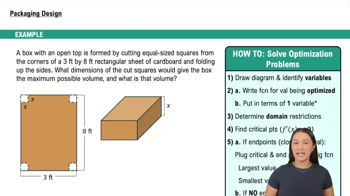
Example 5: Packaging Design

Optimization

Optimization in calculus involves finding the maximum or minimum values of a function. In this context, we need to determine the dimensions that maximize the volume of the box. This typically involves taking the derivative of the volume function, setting it to zero to find critical points, and using the second derivative test to confirm whether these points yield a maximum volume.
Recommended video:
10:13
Intro to Applied Optimization: Maximizing Area

Derivatives

Derivatives represent the rate of change of a function and are fundamental in finding local maxima and minima. In this problem, we will differentiate the volume function with respect to the variable x, which represents the dimensions of the cuts. Analyzing the derivative helps identify critical points where the volume could be maximized, guiding us to the optimal dimensions for the box.
Recommended video:
05:44
Derivatives