Ch. 2 - Limits and Continuity
Hass - Thomas' Calculus 15th Edition
Hass15th EditionThomas' CalculusISBN: 9780137616077Not the one you use?Change textbook
Chapter 2, Problem 2.5.25

At what points are the functions in Exercises 13–30 continuous?


y = √(2x + 3)

Verified step by step guidance
1
Step 1: Understand the concept of continuity. A function is continuous at a point if the limit of the function as it approaches the point from both sides is equal to the function's value at that point.
Step 2: Identify the domain of the function y = √(2x + 3). The expression inside the square root, 2x + 3, must be greater than or equal to zero for the function to be defined.
Step 3: Solve the inequality 2x + 3 ≥ 0 to find the values of x for which the function is defined. This will give you the domain of the function.
Step 4: Since the square root function is continuous wherever it is defined, the function y = √(2x + 3) will be continuous for all x within the domain found in Step 3.
Step 5: Conclude that the function is continuous at all points within the domain determined by the inequality 2x + 3 ≥ 0.

Verified video answer for a similar problem:

This video solution was recommended by our tutors as helpful for the problem above.
Video duration:
1m
Was this helpful?

Key Concepts

Here are the essential concepts you must grasp in order to answer the question correctly.

Continuity of Functions

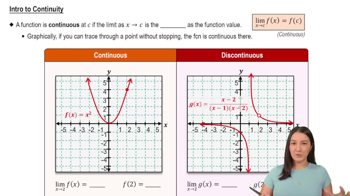
A function is continuous at a point if the limit of the function as it approaches that point equals the function's value at that point. This means there are no breaks, jumps, or holes in the graph of the function at that point. For a function to be continuous over an interval, it must be continuous at every point within that interval.
Recommended video:
05:34
Intro to Continuity

Domain of a Function

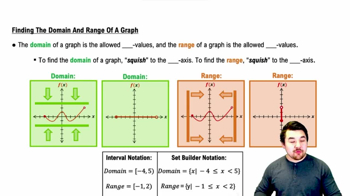
The domain of a function is the set of all possible input values (x-values) for which the function is defined. For the function y = √(2x + 3), the expression under the square root must be non-negative, which imposes restrictions on the values of x. Identifying the domain is crucial for determining where the function is continuous.
Recommended video:
5:10
Finding the Domain and Range of a Graph

Square Root Function Properties

The square root function, such as y = √(x), is defined only for non-negative values of x. This means that for the function y = √(2x + 3), we need to ensure that the expression 2x + 3 is greater than or equal to zero. Understanding these properties helps in finding the intervals where the function is continuous.
Recommended video:
06:21
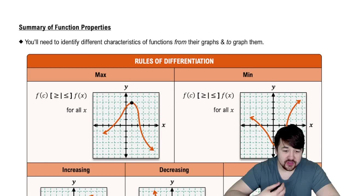
Properties of Functions