Ch. 2 - Limits and Continuity
Hass - Thomas' Calculus 15th Edition
Hass15th EditionThomas' CalculusISBN: 9780137616077Not the one you use?Change textbook
Chapter 2, Problem 29b

[Technology Exercise] Roots


Let Ζ’(𝓍) = 𝓍³ ―𝓍― 1.


b. Solve the equation Ζ’(𝓍) = 0 graphically with an error of magnitude at most 10⁻⁸ .

Verified step by step guidance
1
Start by understanding the function Ζ’(𝓍) = 𝓍³ - 𝓍 - 1. This is a cubic function, and we are tasked with finding its roots, i.e., the values of 𝓍 for which Ζ’(𝓍) = 0.
Graph the function Ζ’(𝓍) using a graphing tool or software. This will help visualize where the function crosses the x-axis, indicating the roots. Look for points where the curve intersects the x-axis.
Use a numerical method such as the Newton-Raphson method to refine the root estimates obtained from the graph. This method involves iterating using the formula: π“β‚™β‚Šβ‚ = 𝓍ₙ - Ζ’(𝓍ₙ) / Ζ’'(𝓍ₙ), where Ζ’'(𝓍) is the derivative of Ζ’(𝓍).
Calculate the derivative of the function Ζ’(𝓍) = 𝓍³ - 𝓍 - 1, which is Ζ’'(𝓍) = 3𝓍² - 1. Use this derivative in the Newton-Raphson formula to iteratively find a more accurate root.
Continue iterating using the Newton-Raphson method until the difference between successive approximations is less than 10⁻⁸, ensuring the error magnitude is within the specified tolerance.

Verified video answer for a similar problem:

This video solution was recommended by our tutors as helpful for the problem above.
Video duration:
5m
Was this helpful?

Key Concepts

Here are the essential concepts you must grasp in order to answer the question correctly.

Roots of a Function

The roots of a function are the values of the variable for which the function equals zero. In this case, we are looking for the values of 𝓍 that satisfy the equation Ζ’(𝓍) = 0. Finding roots is essential in understanding the behavior of functions and their intersections with the x-axis.
Recommended video:
7:24
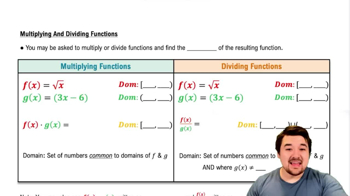
Multiplying & Dividing Functions

Graphical Method for Finding Roots

The graphical method involves plotting the function on a coordinate system and visually identifying where the curve intersects the x-axis. This method provides an intuitive understanding of the function's behavior and can be used to approximate roots, especially when combined with numerical techniques to achieve a specified error margin.
Recommended video:
6:47
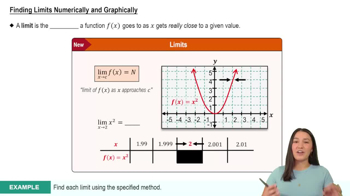
Finding Limits Numerically and Graphically

Error Tolerance in Numerical Methods

Error tolerance refers to the acceptable range of error when approximating solutions, in this case, a maximum of 10⁻⁸. In numerical methods, achieving a solution within this tolerance ensures that the root found is sufficiently accurate for practical purposes, which is crucial when using graphical or iterative methods to solve equations.
Recommended video:
04:57
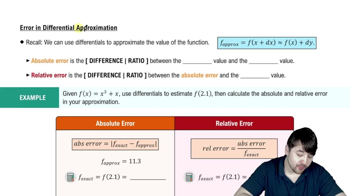
Determining Error and Relative Error
Related Practice
Textbook Question

The accompanying graph shows the total distance s traveled by a bicyclist after t hours.

b. Estimate the bicyclist’s instantaneous speed at the times t=1/2, t=2, and t=3.

400
views

Textbook Question

The accompanying graph shows the total amount of gasoline A in the gas tank of an automobile after it has been driven for t days.

c. Estimate the maximum rate of gasoline consumption and the specific time at which it occurs.

315
views
Textbook Question

Finding Deltas Algebraically


Each of Exercises 15–30 gives a function f(x) and numbers L, c, and Ξ΅>0. In each case, find the largest open interval about c on which the inequality |f(x)βˆ’L| <Ξ΅ holds. Then give a value for Ξ΄>0 such that for all x satisfying 0 < |xβˆ’c| < Ξ΄, the inequality |f(x)βˆ’L| < Ξ΅ holds.


f(x) = mx, m > 0, L = 2m, c = 2, Ξ΅ = 0.03

306
views
Textbook Question

Continuous Extension


Explain why the function Ζ’(𝓍) = sin(1/𝓍) has no continuous extension to 𝓍 = 0.

418
views
Textbook Question

[Technology Exercise] Roots


Let Ζ’(𝓍) = 𝓍³ ―𝓍― 1.


c. It can be shown that the exact value of the solution in part (b) is


(1/2 + √69/18)ΒΉ/Β³ + (1/2 ― √69/18)ΒΉ/Β³


Evaluate this exact answer and compare it with the value you found in part (b).

168
views
Textbook Question

[Technology Exercise] In Exercises 33–36, graph the function to see whether it appears to have a continuous extension to the given point a. If it does, use Trace and Zoom to find a good candidate for the extended function’s value at a. If the function does not appear to have a continuous extension, can it be extended to be continuous from the right or left? If so, what do you think the extended function’s value should be?


g(ΞΈ) = 5 cos ΞΈ / (4ΞΈ ― 2Ο€) , a = Ο€/2

248
views