5–8. Calculate dy/dx using implicit differentiation. x = y²
Verified step by step guidance
1
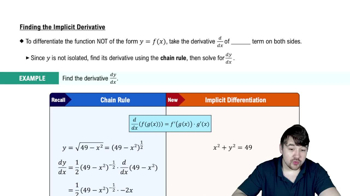
Start by understanding the concept of implicit differentiation. This technique is used when you have an equation involving both x and y, and you want to find the derivative of y with respect to x without solving for y explicitly.
Given the equation x = y², differentiate both sides with respect to x. Remember that y is a function of x, so when differentiating y², you need to apply the chain rule.
Differentiate the left side of the equation: The derivative of x with respect to x is 1.
Differentiate the right side of the equation: The derivative of y² with respect to x is 2y(dy/dx), using the chain rule. Here, you differentiate y² with respect to y, which gives 2y, and then multiply by dy/dx because y is a function of x.
Set the derivatives equal to each other: 1 = 2y(dy/dx). Solve for dy/dx by isolating it on one side of the equation. This involves dividing both sides by 2y.
Verified video answer for a similar problem:
This video solution was recommended by our tutors as helpful for the problem above
Video duration:
2m
Play a video:
0 Comments
Key Concepts
Here are the essential concepts you must grasp in order to answer the question correctly.
Implicit Differentiation
Implicit differentiation is a technique used to find the derivative of a function when it is not explicitly solved for one variable in terms of another. Instead of isolating y, we differentiate both sides of the equation with respect to x, applying the chain rule when necessary. This method is particularly useful for equations where y cannot be easily expressed as a function of x.
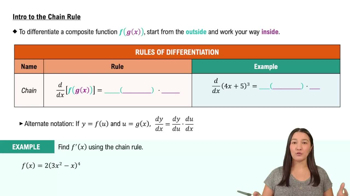
The chain rule is a fundamental principle in calculus that allows us to differentiate composite functions. It states that if a function y is defined as a function of u, which in turn is a function of x, then the derivative of y with respect to x can be found by multiplying the derivative of y with respect to u by the derivative of u with respect to x. This is essential in implicit differentiation when dealing with terms involving y.
Derivative notation, such as dy/dx, represents the rate of change of y with respect to x. In the context of implicit differentiation, it indicates that y is a function of x, even if it is not explicitly defined. Understanding this notation is crucial for correctly applying differentiation techniques and interpreting the results in the context of the problem.

 2:11 minutes
 Verified step by step guidance
 05:14
05:14