Ch. 1 - Functions
Hass - Thomas' Calculus 15th Edition
Hass15th EditionThomas' CalculusISBN: 9780137616077Not the one you use?Change textbook
Chapter 1, Problem 1.4.29

Finding a Viewing Window


In Exercises 5–30, find an appropriate graphing software viewing window for the given function and use it to display that function’s graph. The window should give a picture of the overall behavior of the function. There is more than one choice, but incorrect choices can miss important aspects of the function.


y = x + (1/10) sin 30x

Verified step by step guidance
1
Identify the components of the function: The function is y = x + \(\frac{1}{10}\) sin(30x). It consists of a linear component, x, and a sinusoidal component, \(\frac{1}{10}\) sin(30x).
Determine the behavior of the linear component: The term x is a linear function with a slope of 1, which means it will increase steadily as x increases.
Analyze the sinusoidal component: The term \(\frac{1}{10}\) sin(30x) is a sine function with an amplitude of \(\frac{1}{10}\) and a frequency of 30. This means it oscillates rapidly with a small amplitude.
Choose an appropriate x-range: Since the sine function has a period of \(\frac{2\pi}{30}\), or \(\frac{\pi}{15}\), choose an x-range that includes several periods to capture the oscillations. A range like [-2, 2] or [-\(\frac{\pi}{15}\), \(\frac{\pi}{15}\)] could be appropriate.
Select an appropriate y-range: The linear component x will dominate the overall behavior, but the sine component will cause small oscillations. Choose a y-range that accommodates the linear growth and the small oscillations, such as [-2, 2] or [-1, 1].

Verified video answer for a similar problem:

This video solution was recommended by our tutors as helpful for the problem above.
Video duration:
8m
Was this helpful?

Key Concepts

Here are the essential concepts you must grasp in order to answer the question correctly.

Graphing Functions

Graphing functions involves plotting the function's output values (y-values) against its input values (x-values) on a coordinate plane. This visual representation helps in understanding the behavior and characteristics of the function, such as its growth, periodicity, and any asymptotic behavior. Choosing an appropriate viewing window is crucial to capture the essential features of the function without missing important details.
Recommended video:
5:53
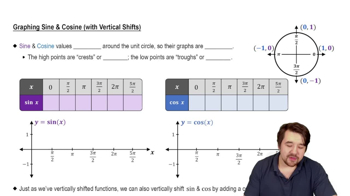
Graph of Sine and Cosine Function

Periodicity and Amplitude

Periodicity refers to the repeating nature of a function over regular intervals, which is a key feature of trigonometric functions like sine. The amplitude is the maximum extent of a function's oscillation, measured from its equilibrium position. In the function y = x + (1/10) sin 30x, the sine component has a small amplitude (1/10) and a high frequency (30x), affecting the choice of viewing window to ensure these oscillations are visible.
Recommended video:
3:40
Introduction to Cotangent Graph Example 1

Linear and Trigonometric Combination

The function y = x + (1/10) sin 30x is a combination of a linear function (y = x) and a trigonometric function (sin 30x). The linear component contributes a steady increase, while the trigonometric component adds oscillations. Understanding how these components interact is essential for selecting a viewing window that accurately represents the overall behavior, capturing both the linear trend and the periodic fluctuations.
Recommended video:
07:17
Linearization