If f′(x)=3x+2, find the slope of the line tangent to the curve y=f(x) at x=1, 2, and 3.
Ch. 3 - Derivatives
Briggs3rd EditionCalculus: Early TranscendentalsISBN: 9780136847243Not the one you use?Change textbook
Chapter 3, Problem 3.5.85
Continuity of a piecewise function Let g(x) = <matrix 2x1> For what values of a is g continuous?
Verified step by step guidance1
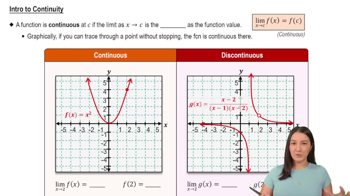
First, understand the concept of continuity for a function. A function is continuous at a point if the limit of the function as it approaches the point from both sides is equal to the function's value at that point.
Identify the piecewise function g(x) given in the problem. Since the problem does not specify the pieces, assume g(x) is defined differently on different intervals. For example, g(x) might be defined as g(x) = x^2 for x < a and g(x) = 2x + 1 for x ≥ a.
To determine the values of 'a' for which g(x) is continuous, ensure that the left-hand limit and right-hand limit at x = a are equal, and also equal to g(a). This means you need to solve the equation: lim(x -> a^-) g(x) = lim(x -> a^+) g(x) = g(a).
Calculate the left-hand limit: lim(x -> a^-) g(x). If g(x) = x^2 for x < a, then this limit is a^2.
Calculate the right-hand limit: lim(x -> a^+) g(x). If g(x) = 2x + 1 for x ≥ a, then this limit is 2a + 1. Set the left-hand limit equal to the right-hand limit and solve for 'a': a^2 = 2a + 1.

Verified video answer for a similar problem:
This video solution was recommended by our tutors as helpful for the problem above.
Video duration:
2mWas this helpful?
Key Concepts
Here are the essential concepts you must grasp in order to answer the question correctly.
Continuity
A function is continuous at a point if the limit of the function as it approaches that point equals the function's value at that point. For piecewise functions, continuity must be checked at the boundaries where the pieces meet. This involves ensuring that the left-hand limit, right-hand limit, and the function's value at that point are all equal.
Recommended video:
Intro to Continuity
Piecewise Function
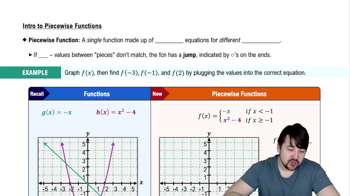
A piecewise function is defined by different expressions based on the input value. Each segment of the function applies to a specific interval of the domain. Understanding how to evaluate and analyze each piece is crucial for determining overall properties like continuity and differentiability.
Recommended video:
Piecewise Functions
Limit
The limit of a function describes the behavior of the function as it approaches a particular point from either side. In the context of continuity, limits are used to determine if the function approaches the same value from both directions at a point of interest. Evaluating limits is essential for confirming the continuity of piecewise functions at their transition points.
Recommended video:
One-Sided Limits
Related Practice
Textbook Question
306
views
Textbook Question
Use Theorem 3.10 to evaluate the following limits.
lim x🠂0 (tan 7x) / (sin x)
358
views
Textbook Question
Calculate the derivative of the following functions. In some cases, it is useful to use the properties of logarithms to simplify the functions before computing f'(x).
y = (cos x) In cos²x
206
views
Textbook Question
47–56. Derivatives of inverse functions at a point Consider the following functions. In each case, without finding the inverse, evaluate the derivative of the inverse at the given point.
f(x)=tan x; (1,π/4)
148
views
Textbook Question
5–8. Calculate dy/dx using implicit differentiation.
x = y²
342
views
Textbook Question
Calculate the derivative of the following functions. In some cases, it is useful to use the properties of logarithms to simplify the functions before computing f'(x).
y = 4 log₃(x²−1)
205
views