Ch. 2 - Limits
Briggs - Calculus: Early Transcendentals 3rd Edition
Briggs3rd EditionCalculus: Early TranscendentalsISBN: 9780136847243Not the one you use?Change textbook
Chapter 2, Problem 61

Determine the interval(s) on which the following functions are continuous; then analyze the given limits. 


f(x)=csc x;lim x→π/4f (x);lim x→2π^− f(x)

Verified step by step guidance
1
The function \( f(x) = \csc x \) is defined as \( \csc x = \frac{1}{\sin x} \). Therefore, \( f(x) \) is undefined where \( \sin x = 0 \). These points occur at \( x = n\pi \), where \( n \) is an integer.
Since \( f(x) = \csc x \) is undefined at \( x = n\pi \), it is continuous on the intervals \( (n\pi, (n+1)\pi) \) for all integers \( n \).
Since \( \pi/4 \) is within the interval \( (0, \pi) \) where \( \csc x \) is continuous, the limit \( \lim_{x \to \pi/4} \csc x \) can be evaluated directly by substituting \( x = \pi/4 \) into \( \csc x \).
The notation \( 2\pi^- \) indicates approaching \( 2\pi \) from the left. Since \( \csc x \) is undefined at \( x = 2\pi \), we need to consider the behavior of \( \csc x \) as \( x \) approaches \( 2\pi \) from the left.
As \( x \to 2\pi^- \), \( \sin x \to 0 \) from the positive side, causing \( \csc x = \frac{1}{\sin x} \) to approach infinity. Thus, \( \lim_{x \to 2\pi^-} \csc x = +\infty \).

Verified video answer for a similar problem:

This video solution was recommended by our tutors as helpful for the problem above.
Video duration:
3m
Was this helpful?

Key Concepts

Here are the essential concepts you must grasp in order to answer the question correctly.

Continuity of Functions

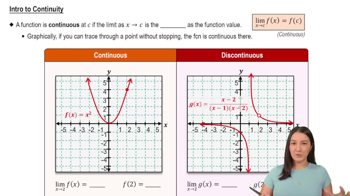
A function is continuous at a point if the limit of the function as it approaches that point equals the function's value at that point. For a function to be continuous over an interval, it must be continuous at every point within that interval. Understanding the conditions for continuity, such as the absence of discontinuities like holes or vertical asymptotes, is essential for determining where a function is continuous.
Recommended video:
05:34
Intro to Continuity

Cosecant Function

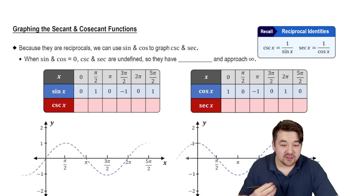
The cosecant function, denoted as csc(x), is the reciprocal of the sine function, defined as csc(x) = 1/sin(x). This function is undefined wherever sin(x) = 0, which occurs at integer multiples of π. Therefore, analyzing the continuity of f(x) = csc(x) requires identifying these points of discontinuity, which will affect the intervals of continuity.
Recommended video:
6:22
Graphs of Secant and Cosecant Functions

Limits

Limits describe the behavior of a function as it approaches a specific point from either side. In this context, evaluating limits such as lim x→π/4 f(x) and lim x→2π^− f(x) involves determining the value that f(x) approaches as x gets close to π/4 and 2π, respectively. Understanding how to compute limits, especially at points of discontinuity, is crucial for analyzing the function's behavior in these scenarios.
Recommended video:
05:50
One-Sided Limits