


Ch. 4 - Applications of the Derivative
Briggs - Calculus: Early Transcendentals 3rd Edition
Briggs3rd EditionCalculus: Early TranscendentalsISBN: 9780136847243Not the one you use?Change textbook
Chapter 4, Problem 4.6.65

Differentials Consider the following functions and express the relationship between a small change in x and the corresponding change in y in the form dy = f'(x)dx.


f(x) = 2 - a cos x, a constant

Verified step by step guidance
1
Identify the function given: \( f(x) = 2 - a \cos x \), where \( a \) is a constant.
To find the differential \( dy \), we first need to compute the derivative of \( f(x) \) with respect to \( x \).
Differentiate \( f(x) \) using the derivative of cosine: \( \frac{d}{dx}[\cos x] = -\sin x \). Thus, \( f'(x) = 0 - a(-\sin x) = a \sin x \).
Express the differential \( dy \) in terms of \( dx \) using the derivative: \( dy = f'(x)dx = a \sin x \, dx \).
The relationship between a small change in \( x \) and the corresponding change in \( y \) is given by \( dy = a \sin x \, dx \).

Verified video answer for a similar problem:

This video solution was recommended by our tutors as helpful for the problem above.
Video duration:
2m
Was this helpful?

Key Concepts

Here are the essential concepts you must grasp in order to answer the question correctly.

Differentials

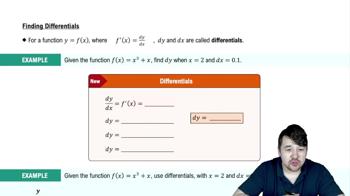
Differentials represent the infinitesimally small changes in variables. In calculus, if y is a function of x, the differential dy is defined as dy = f'(x)dx, where f'(x) is the derivative of the function at a point x, and dx is a small change in x. This relationship helps in approximating how y changes in response to small changes in x.
Recommended video:
05:53
Finding Differentials

Derivatives

The derivative of a function measures the rate at which the function's value changes as its input changes. It is defined as the limit of the average rate of change of the function over an interval as the interval approaches zero. In the context of the given function, f'(x) will provide the slope of the tangent line at any point, indicating how y changes with respect to x.
Recommended video:
05:44
Derivatives

Chain Rule

The chain rule is a fundamental theorem in calculus used to differentiate composite functions. It states that if a function y = f(g(x)) is composed of two functions, the derivative can be found by multiplying the derivative of the outer function by the derivative of the inner function. This concept is essential when dealing with functions that involve constants or other functions, as it allows for the correct computation of derivatives in complex scenarios.
Recommended video:
05:02
Intro to the Chain Rule
Related Practice
Textbook Question

{Use of Tech} Finding intersection points Use Newton’s method to approximate all the intersection points of the following pairs of curves. Some preliminary graphing or analysis may help in choosing good initial approximations.


y = sin x and y = x/2

255
views
Textbook Question

{Use of Tech} Tumor size In a study conducted at Dartmouth College, mice with a particular type of cancerous tumor were treated with the chemotherapy drug Cisplatin. If the volume of one of these tumors at the time of treatment is V₀, then the volume of the tumor t days after treatment is modeled by the function V(t) = V₀ (0.99e⁻⁰·¹²¹⁶ᵗ + 0.01e⁰·²³⁹ᵗ). (Source: Undergraduate Mathematics for the Life Sciences, MAA Notes No. 81, 2013)


Plot a graph of y = 0.99e⁻⁰·¹²¹⁶ᵗ + 0.01e⁰·²³⁹ᵗ, for 0 ≤ t ≤ 16, and describe the tumor size over time. Use Newton’s method to determine when the tumor decreases to half of its original size.

192
views
Textbook Question

Covering a marble Imagine a flat-bottomed cylindrical pot with a circular cross section of radius 4. A marble with radius 0 < r < 4 is placed in the bottom of the pot. What is the radius of the marble that requires the most water to cover it completely?

261
views
Textbook Question

Mean Value Theorem and the police A state patrol officer saw a car start from rest at a highway on-ramp. She radioed ahead to a patrol officer 30 mi along the highway. When the car reached the location of the second officer 28 min later, it was clocked going 60 mi/hr. The driver of the car was given a ticket for exceeding the 60-mi/hr speed limit. Why can the officer conclude that the driver exceeded the speed limit?

311
views
Textbook Question

Closest point on a curve What point on the parabola y = 1 - x² is closest to the point (1, 1)?

303
views
Textbook Question

Shortest ladder A 10-ft-tall fence runs parallel to the wall of a house at a distance of 4 ft. Find the length of the shortest ladder that extends from the ground to the house without touching the fence. Assume the vertical wall of the house and the horizontal ground have infinite extent.

333
views
1
rank