Ch. 3 - Derivatives
Briggs - Calculus: Early Transcendentals 3rd Edition
Briggs3rd EditionCalculus: Early TranscendentalsISBN: 9780136847243Not the one you use?Change textbook
Chapter 3, Problem 3.R.56

Evaluate and simplify y'.
xy⁴+x⁴y=1

Verified step by step guidance
1
First, recognize that the given equation is implicit: \( y \cdot x y^4 + x^4 y = 1 \). We need to differentiate both sides with respect to \( x \).
Apply the product rule to the term \( y \cdot x y^4 \). The product rule states that \( (uv)' = u'v + uv' \). Here, let \( u = y \) and \( v = x y^4 \). Differentiate \( u \) and \( v \) with respect to \( x \).
Differentiate \( u = y \) with respect to \( x \) to get \( u' = y' \). For \( v = x y^4 \), apply the product rule again: \( v' = (x)' y^4 + x (y^4)' \). Differentiate \( x \) to get 1, and \( y^4 \) using the chain rule to get \( 4y^3 y' \).
Now, differentiate the second term \( x^4 y \) using the product rule: \( (x^4 y)' = (x^4)' y + x^4 (y)' \). Differentiate \( x^4 \) to get \( 4x^3 \), and \( y \) to get \( y' \).
Combine all differentiated terms and set the derivative of the right side of the equation, which is 0, equal to the derivative of the left side. Solve for \( y' \) to find the expression for the derivative.

Verified video answer for a similar problem:

This video solution was recommended by our tutors as helpful for the problem above.
Video duration:
5m
Was this helpful?

Key Concepts

Here are the essential concepts you must grasp in order to answer the question correctly.

Implicit Differentiation

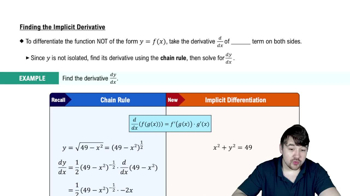
Implicit differentiation is a technique used to differentiate equations where the dependent and independent variables are not explicitly separated. In this case, we differentiate both sides of the equation xy⁴ + x⁴y = 1 with respect to x, treating y as a function of x. This allows us to find the derivative y' without needing to solve for y explicitly.
Recommended video:
05:14
Finding The Implicit Derivative

Product Rule

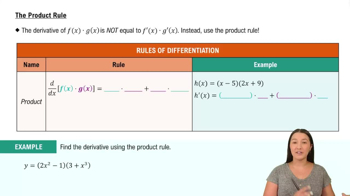
The product rule is a fundamental rule in calculus used to differentiate products of two functions. It states that if you have two functions u(x) and v(x), the derivative of their product is given by u'v + uv'. In the context of the given equation, we will apply the product rule to differentiate terms like xy⁴ and x⁴y, where both x and y are functions of x.
Recommended video:
05:18
The Product Rule

Chain Rule

The chain rule is a method for differentiating composite functions. It states that if a variable y depends on u, which in turn depends on x, then the derivative of y with respect to x is the product of the derivative of y with respect to u and the derivative of u with respect to x. In this problem, we will use the chain rule to differentiate terms involving y, as y is implicitly defined in terms of x.
Recommended video:
05:02
Intro to the Chain Rule